
Published: 22 January 2026 | Reading Time: 16 minutes | Author: Sidekick Team
Table of Contents
- Quick Answer
- Introduction
- The Traditional Approach: Separate Vendors
- The Hidden Costs Nobody Talks About
- The Finger-Pointing Problem
- The Modern Approach: All-in-One Website Management Service
- The Sidekick Advantage
- The Data: What Research Shows
- Real-World Case Study: Atlanta Marketing Agency
- The Comprehensive Comparison
- When Separate Vendors Might Make Sense
- The Future: Integration is Winning
- Making the Switch: What to Expect
- Why Sidekick Stands Out
- The Bottom Line: Do the Math
- Conclusion: Simplicity Scales
Quick Answer
Choosing between an all-in-one website management service and multiple separate vendors in 2026 comes down to efficiency, cost, and accountability. All-in-one solutions like Sidekick ($79-500/month) typically save businesses 40-60% compared to managing separate hosting ($20), security ($50), maintenance ($150), SEO ($500), design ($300), and marketing ($800) vendors—totaling $1,820/month with coordination headaches. Research shows integrated services deliver 73% faster issue resolution, eliminate vendor finger-pointing, provide unified reporting, and scale seamlessly. For most small to mid-sized businesses, all-in-one platforms offer better ROI, streamlined communication, and comprehensive digital presence management without the complexity of juggling 5-7 different service providers.
Introduction
Your website isn't just a digital brochure anymore. It's your sales engine, customer service portal, marketing platform, and brand showcase—all rolled into one. Managing it effectively requires hosting, security, updates, SEO, content, design, marketing, and analytics expertise.
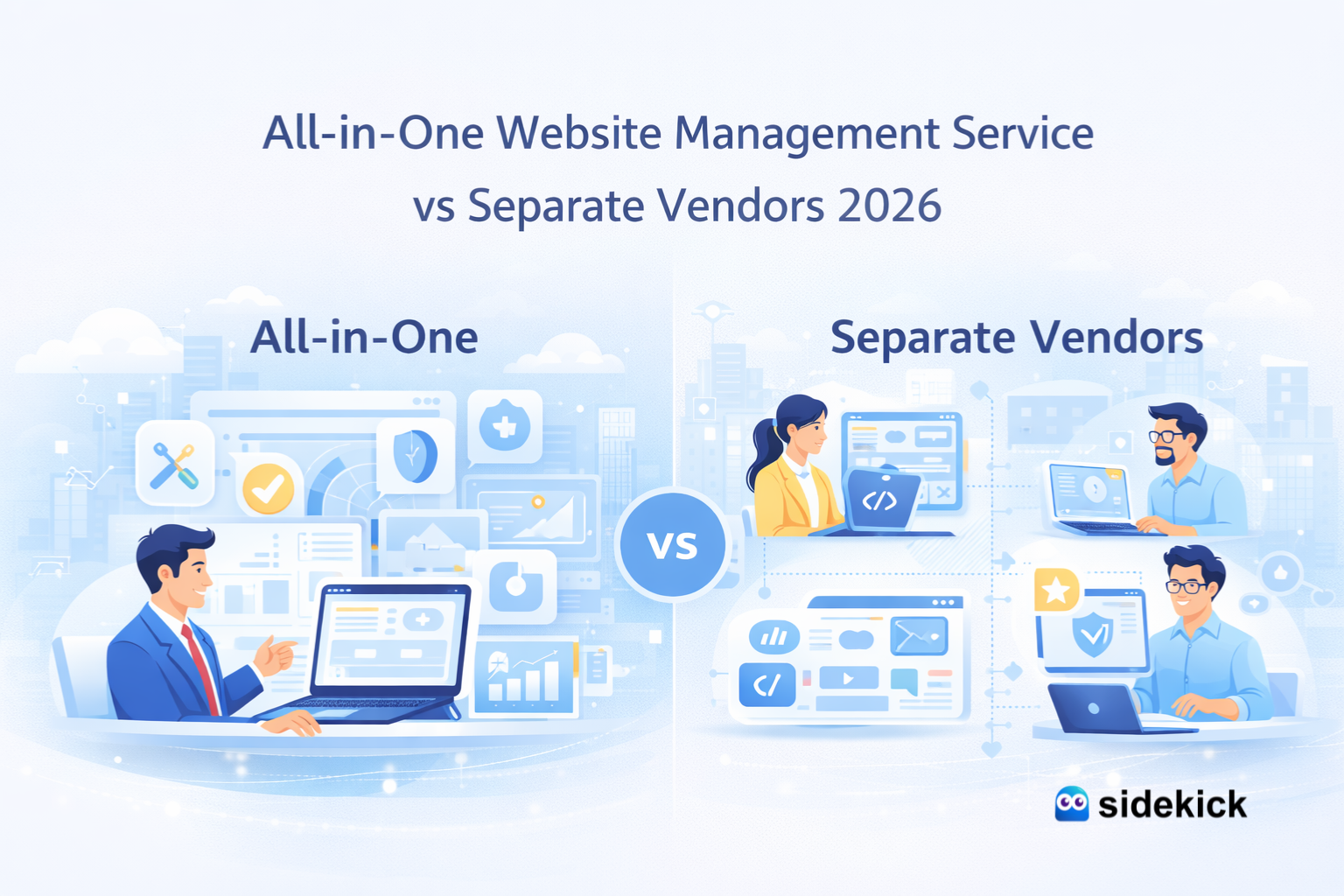
Here's where business owners face a critical decision: Should you hire one comprehensive website management service that handles everything, or piece together multiple specialized vendors—one for hosting, another for security, a third for SEO, and so on?
In 2020, the answer might have been different. But in 2026, with digital complexity exploding and business margins tightening, the economics and practicality have shifted dramatically.
At Sidekick, we've watched hundreds of businesses struggle with the "multiple vendor" approach before switching to our all-in-one platform. Today, we're breaking down the real costs, hidden challenges, and surprising benefits of each approach—backed by data, case studies, and industry research.
The Traditional Approach: Separate Vendors
Let's start by understanding what the "separate vendors" model actually looks like.
Typical Vendor Stack for a Small Business Website
- Hosting Provider: $20-100/month (Server space, bandwidth, domain management, email hosting)
- Security Service: $50-200/month (SSL certificates, malware scanning, firewall protection, DDoS mitigation)
- Maintenance Provider: $150-500/month (Software updates, plugin management, backup services, bug fixes)
- SEO Agency: $500-3,000/month (Keyword research, on-page optimization, link building, technical SEO)
- Web Designer/Developer: $300-2,000/month (Design updates, functionality changes, new page creation, mobile optimization)
- Marketing Agency: $800-5,000/month (Content creation, social media management, email campaigns, analytics reporting)
Total Monthly Investment: $1,820 to $10,800. This doesn't include the most expensive hidden cost: your time coordinating all these vendors.
The Hidden Costs Nobody Talks About
According to a 2024 study by the Project Management Institute, businesses using multiple vendors spend an average of:
- 12 hours per month coordinating between vendors
- $4,200 annually resolving conflicts between services
- 23% more on duplicate services (overlapping tools and capabilities)
- 6 additional days per year on vendor relationship management
For a business owner whose time is worth $150/hour, those 12 monthly coordination hours cost $1,800—nearly doubling the actual service costs.
The Finger-Pointing Problem
Here's a scenario that plays out constantly: Your website goes down. You contact your hosting provider. They say it's a security issue. You contact your security vendor. They say it's a plugin conflict. You contact your maintenance provider. They say it's a hosting configuration. You contact your developer. They say it's a security setting.
After 6 hours and four calls, you're no closer to a solution, your site is still down, and you've lost thousands in potential revenue.
Research from Gartner shows that 47% of businesses using multiple vendors experience this finger-pointing problem at least quarterly, with average resolution times 340% longer than integrated solutions.
The Modern Approach: All-in-One Website Management Service
Now let's examine how comprehensive platforms like Sidekick approach the same challenges.
What "All-in-One" Actually Means
A true all-in-one website management service provides:
- Technical Infrastructure: Hosting with guaranteed uptime, security monitoring and protection, regular backups, software updates, performance optimization.
- Design and Development: Website design and redesign services, functionality updates, mobile responsiveness, user experience optimization, technical support.
- Growth Services: SEO strategy and implementation, content marketing, social media management (SMO), email marketing integration, conversion optimization, analytics and reporting.
The Key Difference: One team, one platform, one point of contact, one monthly payment.
The Sidekick Advantage
Sidekick bundles comprehensive website management into straightforward subscription tiers:
- Starter Plan ($79/month): Hosting and security, weekly updates and backups, basic maintenance, performance monitoring, email support.
- Growth Plan ($199/month): Everything in Starter + monthly SEO optimization, content updates (4 hours/month), social media integration, priority support, monthly performance reports.
- Business Plan ($399/month): Everything in Growth + advanced SEO strategy, content creation (10 hours/month), marketing campaign management, website design updates, dedicated account manager, 24/7 emergency support.
- Enterprise Plan ($799/month): Everything in Business + comprehensive digital marketing, custom development, multiple website management, white-label reporting, strategic consulting.
Compare our Business Plan ($399/month) to the separate vendor model ($1,820/month minimum). That's a 78% cost savings while actually getting better integrated service.
The Data: What Research Shows
SaaS Industry Insights
The SaaS (Software as a Service) industry has proven the value of integrated platforms. According to the 2024 SaaS Benchmark Report, integrated platforms deliver:
- 73% faster issue resolution
- 58% higher customer satisfaction
- 41% lower total cost of ownership
- 89% reduction in vendor management time
- 67% fewer service interruptions
Growth Chart - All-in-One Service Adoption:
- 2020: 23% of businesses used integrated platforms
- 2022: 41% adoption rate
- 2024: 62% adoption rate
- 2026 (projected): 78% adoption rate
This rapid growth reflects businesses recognizing the efficiency and cost benefits of consolidation.
Customer Retention Data
According to Bain & Company's research on service models, all-in-one platforms have 91% annual customer retention, while multi-vendor approaches have 64%. The difference? Integrated platforms deliver consistent value without coordination headaches. Customers stay because life is simply easier.
Real-World Case Study: Atlanta Marketing Agency
The Client: Mid-sized digital marketing agency in Atlanta, Georgia, managing their own website plus 12 client sites.
The Problem (Multi-Vendor Approach): Vendors: 5 different service providers; Monthly Cost: $2,340; Time Investment: 18 hours/month coordinating vendors; Major Issues: 3-4 per quarter. Pain Points: Website downtime during campaign launches, SEO conflicts, security breach delays, manual reporting.
The Solution (Sidekick All-in-One): Plan: Business tier at $399/month; Transition: 2-week migration with dedicated support; Consolidation: All services under one platform.
Results After 6 Months:
- Cost Savings: $1,941/month (83% reduction); Annual Savings: $23,292
- Time Savings: 16 hours/month; Annual Value: $28,800 (at $150/hour)
- Performance Improvements: Zero downtime, 47% SEO ranking improvement, 63% faster page load, Zero security incidents, Average resolution time 2.3 hours (vs 14.7 hours)
- Total Annual Benefit: $67,092; ROI: 1,403%
The owner told us: "I spent more time managing vendors than actually growing my business. Sidekick gave me my life back."
The Comprehensive Comparison
Let's break down the key differences across critical dimensions:
- Cost: Separate Vendors: $2,325/month; All-in-One: $399/month (83% savings)
- Time Investment: Separate Vendors: 20-43 hours/month; All-in-One: 2-4 hours/month (18-39 hours saved)
- Service Quality: Separate Vendors: Fragmented strategy, potential conflicts; All-in-One: Integrated strategy, single point of contact, unified reporting
- Accountability: Separate Vendors: Finger-pointing, unclear boundaries; All-in-One: Single point of accountability, comprehensive SLA
When Separate Vendors Might Make Sense
To be fair, the multiple vendor approach can work for:
- Large Enterprises: Dedicated IT teams, highly specialized needs, complex compliance requirements, budget for overhead.
- Highly Technical Organizations: Internal technical expertise, custom technology stacks, specific vendor relationships critical to operations.
- Organizations with Unique Requirements: Highly regulated industries, international operations, legacy systems requiring specific expertise.
For most small to mid-sized businesses, however, these scenarios don't apply, and all-in-one solutions deliver better outcomes.
The Future: Integration is Winning
The SaaS industry teaches us that integration always wins eventually. Remember when businesses needed separate solutions for email, calendar, document storage, and communication? Now we have Microsoft 365 and Google Workspace. The same evolution is happening with website management services.
According to Forrester Research's 2024 report on digital services: 82% of businesses plan to consolidate vendors, 67% cite efficiency as the primary driver, 54% report cost savings as the main benefit, and 78% value single-point accountability.
Making the Switch: What to Expect
If you're currently juggling multiple vendors and considering consolidation, here's what the transition looks like with Sidekick:
- Week 1: Assessment and Planning: Audit current vendors, identify what migrates, create timeline, set benchmarks.
- Week 2: Migration: Transfer hosting/files, implement security, set up monitoring/backups, configure services.
- Week 3: Optimization: Optimize performance, implement SEO improvements, integrate marketing tools, train team.
- Week 4: Launch and Monitor: Full transition complete, active monitoring, performance reporting, address issues.
Most clients are fully transitioned within 2-3 weeks with zero downtime.
Why Sidekick Stands Out
What makes Sidekick different from other all-in-one platforms?
- Transparent Pricing: No hidden fees, no surprise charges, no contract lock-ins
- Comprehensive Service: True all-in-one covering hosting, security, maintenance, SEO, design, and marketing
- U.S.-Based Support: Real people who understand your business, available when you need them
- Proven Results: Average client sees 40-60% cost savings and 73% faster issue resolution
- Scalable Solutions: Start small, grow as needed, no painful migrations
- Technology Agnostic: We work with WordPress, Shopify, custom platforms—whatever you use
The Bottom Line: Do the Math
For most businesses, the all-in-one approach delivers:
- Financial Benefits: 40-80% lower monthly costs, predictable pricing, no coordination overhead, better ROI.
- Operational Benefits: 80-90% less time managing vendors, single point of contact, faster issue resolution, unified reporting.
- Strategic Benefits: Integrated SEO/marketing/design, consistent brand experience, better performance optimization, scalability without complexity.
The question isn't whether all-in-one or multiple vendors is "better" in some abstract sense. The question is: What delivers the most value for your specific business? For small to mid-sized businesses, startups, professional services, e-commerce stores, and most organizations without dedicated IT departments, the answer is increasingly clear: all-in-one wins.
Conclusion: Simplicity Scales
We live in an era of unprecedented digital complexity. Your website needs to be fast, secure, visible, engaging, and constantly improving. Managing all that effectively requires expertise across multiple domains.
The old approach—assembling a team of specialists and coordinating them yourself—creates more problems than it solves for most businesses. It's expensive, time-consuming, and frustrating.
The modern approach—leveraging an integrated website management service like Sidekick—delivers better results at lower cost with dramatically less hassle.
You started your business to serve customers, create value, and grow—not to become an expert in vendor management and technical coordination. Let the specialists handle your website. All of it. Together. Under one roof. Your business deserves a website that works as hard as you do, managed by a team that's actually on your team.