Published: 14 January 2026 | Reading Time: 16 minutes | Author: Sidekick Team
Quick Answer
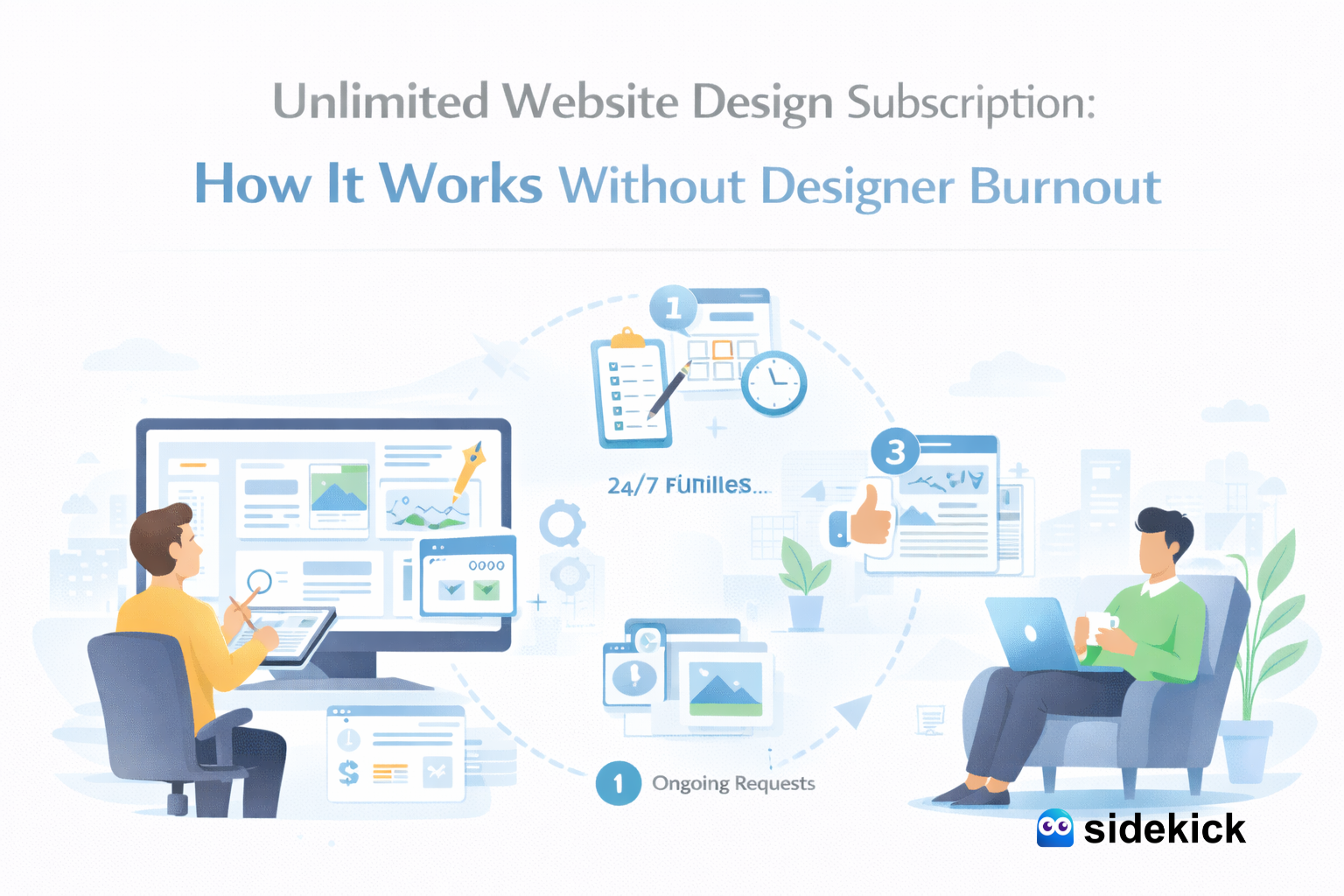
Unlimited website design subscriptions work by combining smart workflow systems, specialized design teams, clear project scoping, and queue-based task management. Services like Sidekick prevent designer burnout through realistic turnaround expectations (2-3 business days per request), limiting active requests per client, automating repetitive tasks, and maintaining sustainable designer workloads. The model thrives on recurring revenue stability that allows proper staffing levels rather than the feast-or-famine cycle that causes traditional agency burnout.
Table of Contents
- Quick Answer
- Understanding the Website Design Subscription Revolution
- The SaaS Industry Context: Why Subscriptions Make Sense
- How the Unlimited Design Model Actually Works
- The Business Model That Prevents Burnout
- Real Growth: The Numbers Behind Subscription Design Services
- Case Study: Small Business Transformation with Subscription Design
- Beyond Design: The Full Website Management Advantage
- The Psychology Behind "Unlimited" That Prevents Abuse
- How American Businesses Benefit from the Subscription Model
- Why Designers Actually Prefer Subscription Models
- The Future of Website Design Subscriptions
- Making the Subscription Model Work: Key Success Factors
- Conclusion: Sustainable Design for the Modern Business
Understanding The Website Design Subscription Revolution
The American web design industry is experiencing a massive shift. Traditional project-based pricing is giving way to subscription models that promise unlimited design work for a flat monthly fee. Sounds impossible, right? How can any company offer unlimited design without their team collapsing from exhaustion?
The answer lies in sophisticated systems that companies like Sidekick have perfected. This isn't about working designers harder—it's about working smarter with proven processes that benefit both clients and creative teams.
The SaaS Industry Context: Why Subscriptions Make Sense
The Software-as-a-Service (SaaS) industry has proven that subscription models work brilliantly when designed correctly. According to recent data from the SaaS Capital Index, subscription-based companies grew revenue by an average of 34% annually between 2020-2024, significantly outpacing traditional service businesses.
Key SaaS Metrics That Apply to Design Subscriptions:
The most successful SaaS companies maintain these benchmarks:
- Customer Lifetime Value (LTV) averaging 3-5 times the Customer Acquisition Cost (CAC)
- Monthly Recurring Revenue (MRR) growth of 10-20% for healthy companies
- Churn rates below 5% monthly for established businesses
- Net Revenue Retention above 100%, meaning existing customers spend more over time
Sidekick applies these same principles to website design services. By generating predictable monthly revenue, the company can maintain stable design teams, invest in better tools, and create systems that prevent the chaos typical of traditional agencies.
How the Unlimited Design Model Actually Works
Let's break down the mechanics that make website design subscription services sustainable and burnout-free.
1. Queue-Based Request Management
Unlike traditional agencies juggling dozens of clients with overlapping deadlines, subscription services use structured queues. Each client submits requests through a dedicated portal or project management system. Requests get added to their queue and completed one at a time or in logical batches.
Sidekick's Approach: Clients submit unlimited requests, but they're processed sequentially with 2-3 business day turnaround per task. This prevents the "everything is urgent" mentality that destroys designer mental health.
2. Smart Task Scoping and Categorization
Not all design requests are equal. A complete website redesign differs massively from updating a homepage banner. Successful subscription services categorize requests clearly:
- Quick tasks: Logo tweaks, color changes, minor text updates (same-day turnaround)
- Standard tasks: Landing page designs, blog graphics, email templates (2-3 days)
- Complex tasks: Full website pages, custom illustrations, extensive revisions (4-7 days)
This categorization helps clients understand realistic timelines while allowing designers to plan their workload effectively.
3. Specialized Team Structures
Traditional agencies often have designers doing everything from website design to social media graphics to print materials. Subscription services specialize.
Sidekick focuses specifically on website design and management, allowing designers to develop deep expertise rather than constantly context-switching between wildly different project types. This specialization increases both quality and speed while reducing the mental fatigue of constant variety.
4. Asynchronous Communication
Real-time communication creates constant interruptions. Subscription services use asynchronous tools—project boards, shared documents, and video messages—allowing designers to work in focused blocks without constant meetings disrupting their flow state.
According to research from the University of California Irvine, it takes an average of 23 minutes to fully refocus after an interruption. By minimizing interruptions, designers accomplish more while feeling less stressed.
5. Active Request Limits
Here's the secret sauce: "unlimited" doesn't mean infinite simultaneous projects. Most services limit clients to 1-3 active requests at once. This seemingly small restriction makes unlimited workable.
Think about it practically—most small to medium businesses don't actually need 20 simultaneous design projects. They need consistent, reliable access to design support without worrying about per-project costs. The queue system satisfies this need while keeping designer workloads manageable.
The Business Model That Prevents Burnout
Traditional agency problems stem from unpredictable revenue and project flow. January might bring 15 new clients while July brings three. This creates hiring problems, cash flow stress, and the pressure to overwork designers during busy periods.
Recurring Revenue Stability
The website design subscription model generates predictable Monthly Recurring Revenue. With consistent income, companies can:
- Maintain appropriate staffing levels year-round rather than panic-hiring during busy seasons
- Invest in designer training and tools without worrying about next month's payroll
- Pay competitive salaries that attract and retain talented designers
- Build realistic buffers into timelines rather than promising impossible deadlines
Sidekick operates on this stability. At $79/month, the service provides affordable access to professional website design while the recurring revenue allows sustainable operations.
Data-Driven Workload Management
Successful subscription services track metrics obsessively:
- Average completion time per request type
- Number of revision rounds per project
- Designer capacity and utilization rates
- Client satisfaction scores
This data helps companies like Sidekick identify when to hire additional designers, which processes need improvement, and which clients might need different service tiers.
Real Growth: The Numbers Behind Subscription Design Services
The subscription design market in the USA has exploded over the past five years. While exact market size data remains proprietary, observable trends tell the story:
Market Growth Indicators:
- Google search volume for "unlimited design services" increased 340% between 2020-2024
- Venture capital investment in subscription creative services topped $200 million in 2023 alone
- Average contract value for design subscriptions ranges from $900-$5,000 monthly depending on service levels
The typical growth trajectory for successful subscription design services follows this pattern:
Year 1: 50-100 clients, focusing on process refinement and service delivery
Year 2: 200-400 clients, hiring additional designers and support staff
Year 3: 500-800 clients, establishing specialized teams and advanced systems
Year 4+: 1000+ clients, achieving significant economies of scale
Companies that survive past year two typically achieve 80%+ client retention rates—remarkable compared to traditional agencies where 30-40% annual client churn is common.
Case Study: Small Business Transformation with Subscription Design
The Client: A Denver-based organic coffee roaster selling directly to consumers through their website.
The Problem: They needed constant website updates—new product photos, seasonal promotions, blog content, landing pages for email campaigns. Hiring a full-time designer wasn't financially viable. Working with traditional agencies meant paying $2,000-$5,000 per project, making them hesitant to request needed changes.
The Sidekick Solution: For $79 monthly, they gained unlimited access to website design support. Over twelve months, they submitted 89 design requests including:
- 24 product page updates with new photography integration
- 12 seasonal landing pages for promotional campaigns
- 18 blog post header graphics and layouts
- 15 homepage banner rotations for different campaigns
- 20 minor updates (color changes, text edits, button adjustments)
The Results:
- Website conversion rate increased from 1.8% to 3.2% due to professionally designed landing pages
- Average order value grew 23% after product pages received design improvements
- Email campaign click-through rates doubled with better-designed landing page experiences
- Total cost of $948 for the year versus estimated $35,000-$50,000 with traditional agency pricing
The business owner reported that removing the mental barrier of "is this design change worth $2,000?" allowed them to continually optimize their website rather than letting it stagnate.
Beyond Design: The Full Website Management Advantage
Modern website design subscription services don't stop at visual design. Companies like Sidekick offer comprehensive website management that includes:
SEO Services Integration
Search engine optimization requires ongoing attention. Subscription services provide:
- Monthly SEO audits identifying technical issues affecting rankings
- Content optimization ensuring pages target relevant keywords naturally
- Page speed optimization improving load times that impact both user experience and Google rankings
- Schema markup implementation helping search engines understand your content better
Small businesses using subscription services with integrated SEO typically see organic traffic increases of 25-40% within six months compared to design-only approaches.
Marketing Services That Complement Design
Great design means nothing without traffic. Progressive subscription services bundle:
- Landing page strategy aligned with advertising campaigns
- Conversion rate optimization through A/B testing and analytics review
- Email template design maintaining brand consistency across channels
- Marketing automation setup using tools like Mailchimp or HubSpot
Sidekick understands that website design exists within a larger marketing ecosystem. Their subscription includes consultation on how design decisions impact broader marketing goals.
Social Media Optimization (SMO)
Your website doesn't exist in isolation. SMO services ensure:
- Social sharing optimization with proper Open Graph and Twitter Card tags
- Visual consistency between website design and social media presence
- Profile and cover graphics that match website branding
- Social proof integration displaying Instagram feeds, testimonials, and reviews
Ongoing Website Maintenance
Technical maintenance prevents small issues from becoming major problems:
- Plugin and CMS updates keeping systems secure and functional
- Regular backups protecting against data loss
- Security monitoring identifying potential vulnerabilities
- Performance optimization maintaining fast load speeds as content grows
For $79 monthly, Sidekick delivers this comprehensive approach rather than just visual design changes.
The Psychology Behind "Unlimited" That Prevents Abuse
You might worry that "unlimited" invites clients to submit hundreds of requests, overwhelming designers. In practice, this rarely happens due to human psychology and smart system design.
- Natural Usage Patterns: Research from subscription service providers shows that most clients average 3-5 requests monthly even with unlimited plans. Businesses have limited bandwidth to define what they need, gather assets, and provide feedback.
- The "Gym Membership Effect": Like gym memberships where most people don't use their unlimited access daily, design subscriptions benefit from clients knowing they could request unlimited work while typically only requesting what they actually need.
- Built-In Friction (The Good Kind): Requiring clear briefs, organized asset delivery, and structured feedback creates just enough process that clients naturally pace themselves without feeling restricted.
How American Businesses Benefit from the Subscription Model
The United States has over 33 million small businesses, most operating on tight budgets. Traditional design services price out the majority of these businesses, leaving them with either:
- DIY designs that look unprofessional
- Cheap overseas options with quality and communication problems
- Expensive agency work they can only afford occasionally
Website design subscriptions democratize access to professional design. A local accounting firm, an e-commerce store, a consulting practice, and a medical office all need consistent design support but can't justify full-time designers or traditional agency retainers.
The subscription model serves this massive middle market—businesses that care about professional presentation but operate on practical budgets.
Why Designers Actually Prefer Subscription Models
Surprisingly, many designers report higher job satisfaction in subscription environments compared to traditional agencies. Here's why:
- Predictable Workloads: No more 70-hour weeks followed by anxious slow periods wondering if layoffs are coming.
- Skill Development: Specialization allows designers to become genuinely expert rather than barely competent at everything.
- Better Client Relationships: Working with the same clients over months builds understanding and trust. Designers become partners rather than vendors.
- Fair Compensation: Stable revenue allows subscription companies to pay market-rate salaries rather than the feast-or-famine compensation typical at traditional agencies.
- Reduced Client Acquisition Stress: Designers can focus on design rather than constantly pitching new business.
The Future of Website Design Subscriptions
Industry analysts predict the subscription design market will grow 300% over the next five years as more businesses discover the model. Several trends are emerging:
- Tiered Service Levels: Basic plans like Sidekick's $79/month offering expanding into premium tiers with faster turnarounds or additional services.
- AI-Assisted Workflows: Artificial intelligence handling repetitive tasks (resizing images, generating variations, basic layouts) while human designers focus on strategy and custom work.
- Vertical Specialization: Subscriptions targeting specific industries (healthcare, legal, real estate) with pre-built templates and compliance knowledge.
- Integration Ecosystems: Subscriptions bundling website design with hosting, domain management, analytics, and marketing automation into comprehensive platforms.
Making the Subscription Model Work: Key Success Factors
For businesses considering website design subscription services, here's what separates successful providers from failures:
- Crystal-Clear Expectations: Clients must understand what "unlimited" means, typical turnaround times, and how requests work.
- Quality Standards: Fast turnaround means nothing if design quality suffers. Successful services maintain portfolio-worthy output.
- Communication Systems: Structured feedback loops and project management tools prevent misunderstandings.
- Scalable Processes: Systems must work whether serving 50 or 500 clients.
- Client Education: Teaching clients to submit better briefs and provide complete assets upfront speeds delivery and improves results.
Sidekick excels at these factors, creating experiences where clients feel supported while designers maintain sustainable workloads.
Conclusion: Sustainable Design for the Modern Business
The unlimited website design subscription model isn't magic—it's smart business operations applied to creative services. By combining predictable recurring revenue, specialized teams, queue-based workflows, and realistic scoping, companies prove that "unlimited" and "sustainable" aren't contradictory.
For American small businesses, services like Sidekick provide ongoing professional design support at prices that actually work within real-world budgets. For designers, the model offers career stability and satisfaction often missing in traditional agency chaos.
The revolution in how businesses access design services isn't coming—it's already here. The question isn't whether subscription models work, but rather which businesses will embrace them quickly enough to gain competitive advantages through consistently professional digital presence.
At $79 monthly, Sidekick represents the accessible future of website design—unlimited support without the burnout, professional quality without the agency prices, and ongoing partnerships rather than transactional projects. That's not just good business; it's the evolution of an entire industry toward sustainability for everyone involved.