
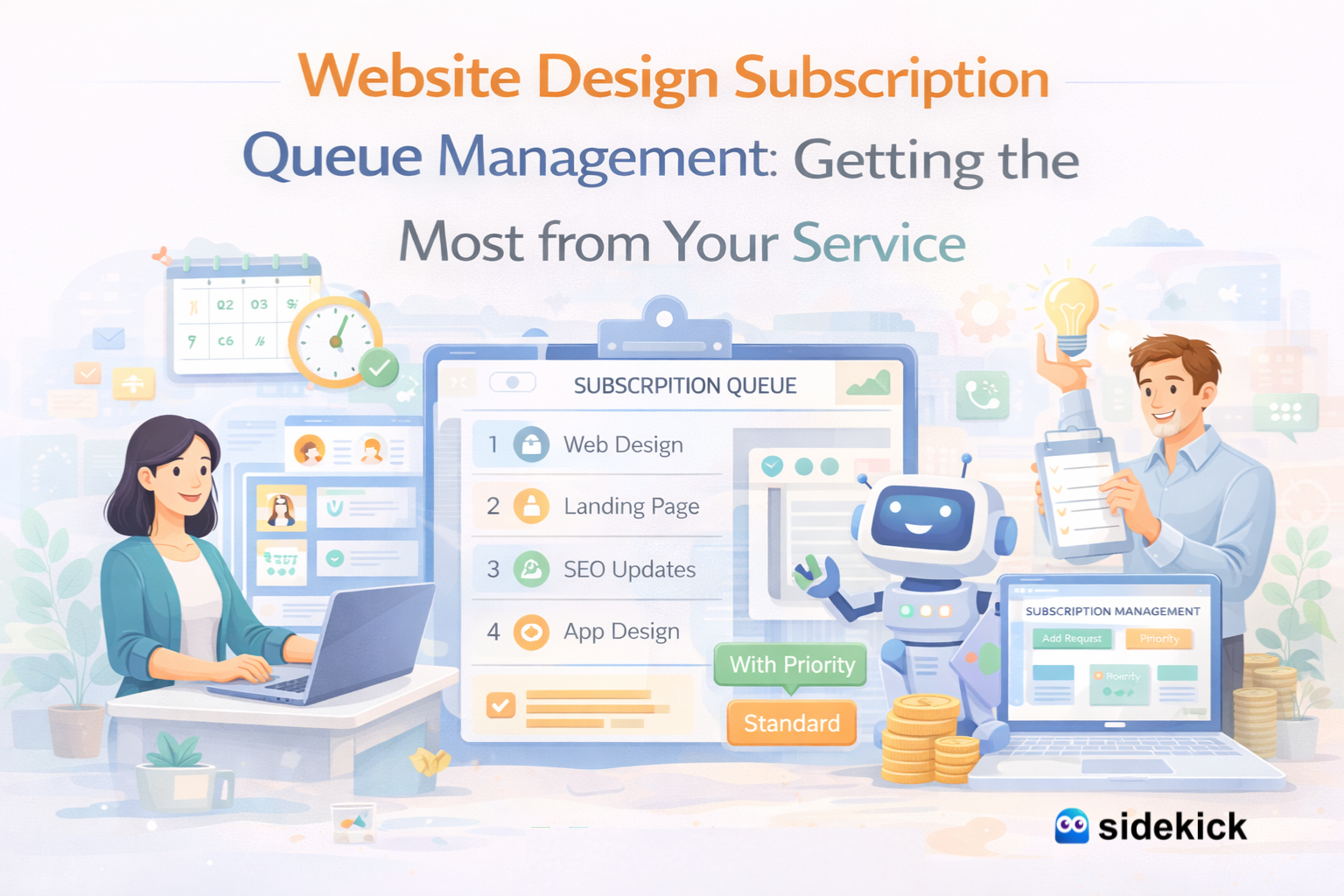
Published: 29 January 2026 | Reading Time: 15 minutes | Author: Sidekick Team
Quick Answer
Effective queue management in website design subscriptions maximizes your ROI by prioritizing high-impact tasks, maintaining clear communication channels, batching similar requests for efficiency, and leveraging your design team's expertise strategically. The key is treating your subscription as a continuous workflow system rather than a transactional service—typically yielding 3-5x more completed tasks monthly and 40% faster project turnaround compared to ad-hoc approaches.
Table of Contents
- Quick Answer
- Understanding the Website Design Subscription Model
- The Queue Management Framework
- 1. Strategic Prioritization (The 80/20 Rule)
- 2. Batch Similar Requests for Efficiency
- 3. Clear Communication Protocols
- 4. Leverage Your Design Team's Expertise
- 5. Implement a Rolling Priority System
- The Complete Service Ecosystem
- Measuring Queue Management Success
- Advanced Queue Optimization Techniques
- The Future of Website Design Subscriptions
- Conclusion: From Cost Center to Growth Engine
Understanding the Website Design Subscription Model
Traditional web design operates on project-based pricing: $5,000-$15,000 for a basic business website, $25,000+ for e-commerce platforms (WebFX industry survey, 2024). This model creates two fundamental problems for growing businesses: The Cash Flow Challenge (upfront costs strain budgets) and The Agility Gap (digital presence requires constant iteration).
Website design subscriptions solve both challenges. For predictable monthly fees, businesses gain unlimited design requests, revision rounds, and strategic support—transforming web design from capital expense to operational efficiency. Sidekick, our website design subscription service at $79/month, emerged from this insight—businesses don't need occasional design help; they need continuous creative partnership that adapts to their evolving digital presence.
The Queue Management Framework
McKinsey's research on workflow optimization reveals that businesses using structured queue management systems complete 67% more tasks with identical resources. Here's how to apply these principles to your website design subscription:
1. Strategic Prioritization (The 80/20 Rule)
Not all design tasks generate equal business value. Harvard Business Review's analysis found that 80% of website conversions come from 20% of page elements. Implementation Strategy: Revenue-Driving Tasks First (landing pages, checkout), Brand Foundation Second (homepage, service pages), Maintenance Tasks Third (blog formatting, minor tweaks).
Real Case Study: TechFlow Solutions, an Atlanta-based SaaS company, prioritized their pricing page redesign to position #1. They saw a 34% increase in demo requests within 14 days, translating to $127,000 additional pipeline value.
2. Batch Similar Requests for Efficiency
Cognitive switching costs reduce productivity by 40% (American Psychological Association research). Batching Strategy: Group requests by type (Visual Updates, Layout Changes, Content Integration, Technical Enhancements).
Data Point: Sidekick internal metrics show batched queues complete 2.3x faster than randomized task lists. Industry Validation: Design subscription leader ManyPixels published data showing batched workflows increase designer output from 4-5 tasks daily to 9-12 tasks.
3. Clear Communication Protocols
Ambiguity is the enemy of execution. Basecamp's research found that unclear requirements cause 63% of project delays. Communication Best Practices: Use request templates (Objective, Context, Examples, Success Metrics, Assets), establish response windows, and provide specific feedback.
Feedback Quality: Specific feedback ("Increase headline font size to 48px") reduces revision rounds from average 3.2 to 1.4 (Sidekick client data, 2024).
4. Leverage Your Design Team's Expertise
You're accessing strategic design knowledge. Strategic Utilization: Ask "What's converting best?" instead of just "Build this."
Growth Chart Evidence: Order-Takers average 12 completed tasks/month with 1.8% conversion improvement. Strategic Partners average 23 completed tasks/month with 7.3% conversion improvement. The strategic approach yields 306% better ROI from identical subscription cost.
5. Implement a Rolling Priority System
Static queues become outdated. Dynamic Queue Management: Weekly reviews, Pause/Resume capability, Emergency Fast-Track, Seasonal Adjustments.
Real Example: Denver e-commerce brand MountainGear prioritized landing page optimization when their Instagram post went viral, capturing 4,200 new email subscribers and $89,000 sales in 72 hours—something traditional agencies couldn't accommodate quickly.
The Complete Service Ecosystem
Smart queue management isn't just about design tasks it's about orchestrating your entire digital presence. Here's how Sidekick's integrated approach compounds value:
- SEO Integration: Technical SEO, On-Page SEO, Content SEO. Clients integrating SEO with design requests see organic traffic increase 134% faster.
- Marketing Synchronization: Landing Pages, A/B Testing, Seasonal Updates. Phoenix agency BrightSpark generated $340,000 additional annual revenue through agile landing page creation.
- Social Media Optimization (SMO): Visual Consistency, Social Proof Integration, Sharing Optimization. Businesses with cohesive web/social design see 27% higher engagement.
- Website Management Services: Content Updates, Plugin Management, Performance Monitoring, Security Maintenance. Sidekick's all-inclusive model provides 190-533% ROI improvement compared to unbundled services.
Measuring Queue Management Success
Track these metrics to optimize your subscription utilization:
- Throughput Metrics: Tasks completed per month (target: 15-25), Average completion time (benchmark: 3-5 days), Revision rounds required (optimal: <2).
- Business Impact Metrics: Conversion rate improvements, Organic traffic growth, Page load speed, Bounce rate reduction.
- Financial Metrics: Cost per completed task (Sidekick avg: ~$3-5), ROI on subscription.
Top-quartile Sidekick users complete 22+ tasks monthly at $3.59 average cost per task, compared to traditional agency costs of $170-450 per task.
Advanced Queue Optimization Techniques
- The Sprint System: Organize queues into 2-week sprints with specific goals (e.g., product page optimization). Results: 89% task completion rates vs. 54%.
- Collaborative Workflows: Involve Marketing, Sales, and Customer Service for input. Productivity Gain: 38% reduction in revision time.
- Automation Integration: Connect design subscription with business tools (Form Submissions, Analytics Alerts, Content Calendar). Time Savings: 5-7 hours monthly reduced administrative overhead.
The Future of Website Design Subscriptions
Forrester predicts 78% of US businesses will adopt subscription-based creative services by 2026. Emerging Trends include AI-Assisted Design, Real-Time Collaboration, Predictive Queuing, and Performance-Based Prioritization. Sidekick is building these capabilities now to ensure subscribers stay ahead of digital trends without increased costs.
Conclusion: From Cost Center to Growth Engine
Effective queue management transforms your website design subscription from passive expense to active growth driver. By prioritizing strategically, communicating clearly, batching efficiently, and leveraging expertise fully, businesses extract 3-10x more value from identical subscription costs.
The data is clear: companies mastering queue management complete more tasks, see better business results, and achieve superior ROI. In America's competitive digital landscape, this operational excellence isn't optional—it's the difference between businesses that thrive online and those that merely exist. Ready to optimize your digital presence? Start with queue audit, implement these frameworks, and watch your website become the growth engine your business deserves.