Published: 24 february 2026 | Reading Time: 13 minutes | Author: Sidekick Team
Quick Answer
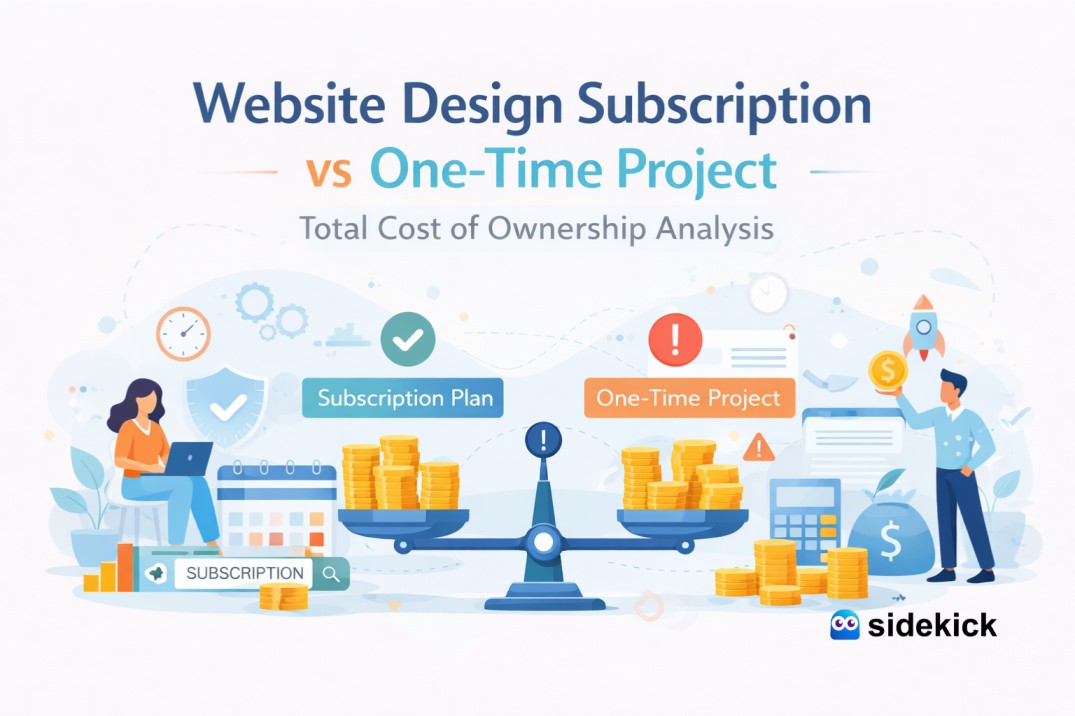
A Website Design Subscription usually has a lower total cost of ownership (TCO) for fast-moving USA businesses because it bundles ongoing updates, fixes, performance, and support into one predictable monthly cost. A one-time website project may look cheaper upfront, but long-term costs often rise due to paid change requests, maintenance, security, speed issues, and repeated redesign cycles.
Table of Contents
- Quick Answer
- What “Total Cost of Ownership” means for a website
- Option 1: One-Time Website Project (what it really costs)
- Option 2: Website Design Subscription (how TCO stays controlled)
- A simple TCO comparison (12 months example)
- “Growth chart” logic: why subscriptions fit the SaaS era
- Case study style example (USA)
- Why Sidekick fits this model (service provider view)
- When a one-time project is still okay
- Final decision guide (simple)
- Conclusion
What “Total Cost of Ownership” means for a website
Most people compare websites like this: “How much does it cost to build?” But the smarter question is: How much does it cost to own and operate for 12–36 months?
TCO includes more than the build:
- Initial design and development
- Ongoing updates (content, pages, banners, forms)
- Security monitoring and plugin updates
- Backups and restore support
- Speed optimization and Core Web Vitals improvements
- SEO fixes (metadata, structure, internal links)
- Marketing landing pages for campaigns
- SMO assets and tracking updates
- Emergency fixes when something breaks
Google itself recommends improving Core Web Vitals for better Search performance and user experience, which becomes part of your ongoing costs either way.
Option 1: One-Time Website Project (what it really costs)
A one-time project works like this: you pay once, you launch, and you’re “done.” But in real business life, you’re not done.
Typical costs you’ll see in the USA
- Initial build: Small business custom sites are often quoted in ranges like $2,000–$5,000 for basic custom builds, with more complex sites costing more.
- Ongoing maintenance: Many sources show maintenance can become a monthly cost depending on site type. For small business sites, $500–$1,000/month is a commonly cited range, and can go higher for bigger sites.
The hidden costs (where TCO jumps)
Change requests: Every new landing page, pricing change, and feature update becomes a separate invoice.
Performance & SEO fixes later: If your site becomes slow, you may lose conversions. Research shows site speed can strongly impact conversion rate; one analysis found a 1-second load time can have far higher conversion than slower loads.
“Redesign again” cycle: Many one-time sites need a refresh every 12–24 months because the startup grows, messaging changes, and the design feels outdated.
Option 2: Website Design Subscription (how TCO stays controlled)
A Website Design Subscription flips the model: instead of paying large upfront and then paying again for every change, you pay a steady monthly fee and keep improving.
What you typically get:
- Ongoing design + web updates
- Website manage services (content edits, fixes, small improvements)
- Speed checks and performance optimization
- Security updates and backups
- SEO support (on-page improvements, structure, metadata)
- Marketing landing pages
- SMO-ready visuals and on-site campaign sections
This is why a Website Design Subscription can lower TCO: fewer surprise costs, fewer emergency fixes, and less downtime.
A simple TCO comparison (12 months example)
Let’s take an easy example for a USA small business/startup site:
One-Time Project model (example)
- Build: $4,000 (common basic custom range)
- Maintenance: $500/month × 12 = $6,000
- Two campaign landing pages + changes: often extra (varies)
- Fixes for speed/SEO: often extra
- Estimated 12-month TCO: $10,000+ (and can easily go higher)
Website Design Subscription model (example)
- One monthly fee that includes updates + ongoing improvement
- Less “per-change billing”
- Less emergency spending
Your exact total depends on the plan, but the key is: predictable cost + continuous improvement.
“Growth chart” logic: why subscriptions fit the SaaS era
In SaaS and tech, change is constant. And the SaaS market is expected to grow significantly—one forecast projects global SaaS market growth from $375.57B (2026) to $1,482.44B (2034).
That market growth means more competition—and your website has to evolve faster: new positioning, new feature pages, new landing pages, new SEO content, new funnels. This is exactly where a Website Design Subscription makes business sense.
Case study style example (USA)
A small USA-based SaaS startup was running paid ads to a homepage that wasn’t built for conversion. Their issues were common: slow landing page, unclear headline, weak social proof, too many steps to request a demo.
They moved to a subscription model with Sidekick, treating the website as an ongoing growth asset, not a one-time project.
What Sidekick did (subscription workflow):
- Built a dedicated ad landing page (clear offer + strong CTA)
- Added trust blocks (logos, testimonials, “results” section)
- Improved mobile layout and speed basics
- Set a monthly cycle for SEO and conversion improvements
- Supported marketing + SMO needs with fresh visuals and sections
Outcome: The site became easier to update every time the startup ran a new campaign. Instead of waiting weeks for a freelancer, they shipped changes faster and kept improving conversion elements monthly.
Why Sidekick fits this model (service provider view)
Sidekick is built for businesses that don’t want to hire a full web team but still need professional outcomes. For USA startups and small business owners, Sidekick’s advantage is:
- Predictable monthly support
- Website manage services included (updates + fixes)
- Design + speed + SEO improvements as an ongoing system
- Marketing support for landing pages and conversion blocks
- SMO support by creating on-site visuals/sections aligned with campaigns
This is what a modern Website Design Subscription should feel like: a growth partner, not a “one-time vendor.”
When a one-time project is still okay
A one-time project can work if your website is truly static (rare), you won’t run campaigns, you don’t need frequent updates, or you have an internal team for maintenance and SEO. But most USA businesses in 2026 need continuous updates for SEO, marketing, and trust-building.
Final decision guide (simple)
Choose Website Design Subscription if you:
- Run ads or campaigns regularly
- Need landing pages often
- Want predictable budgeting
- Care about SEO and performance growth
- Don’t want to hire a full team
Choose One-Time Project if you:
- Need a basic brochure site with minimal updates
- Already have internal tech + marketing support
Conclusion
In 2026, websites are not “launch and forget.” They’re living assets. If you want lower long-term cost, faster marketing execution, and fewer surprise bills, a Website Design Subscription is often the better total cost of ownership decision—especially for USA startups and small business owners.