
Published: 09 January 2026 | Reading Time: 15 minutes | Author: Sidekick Team
Quick Answer
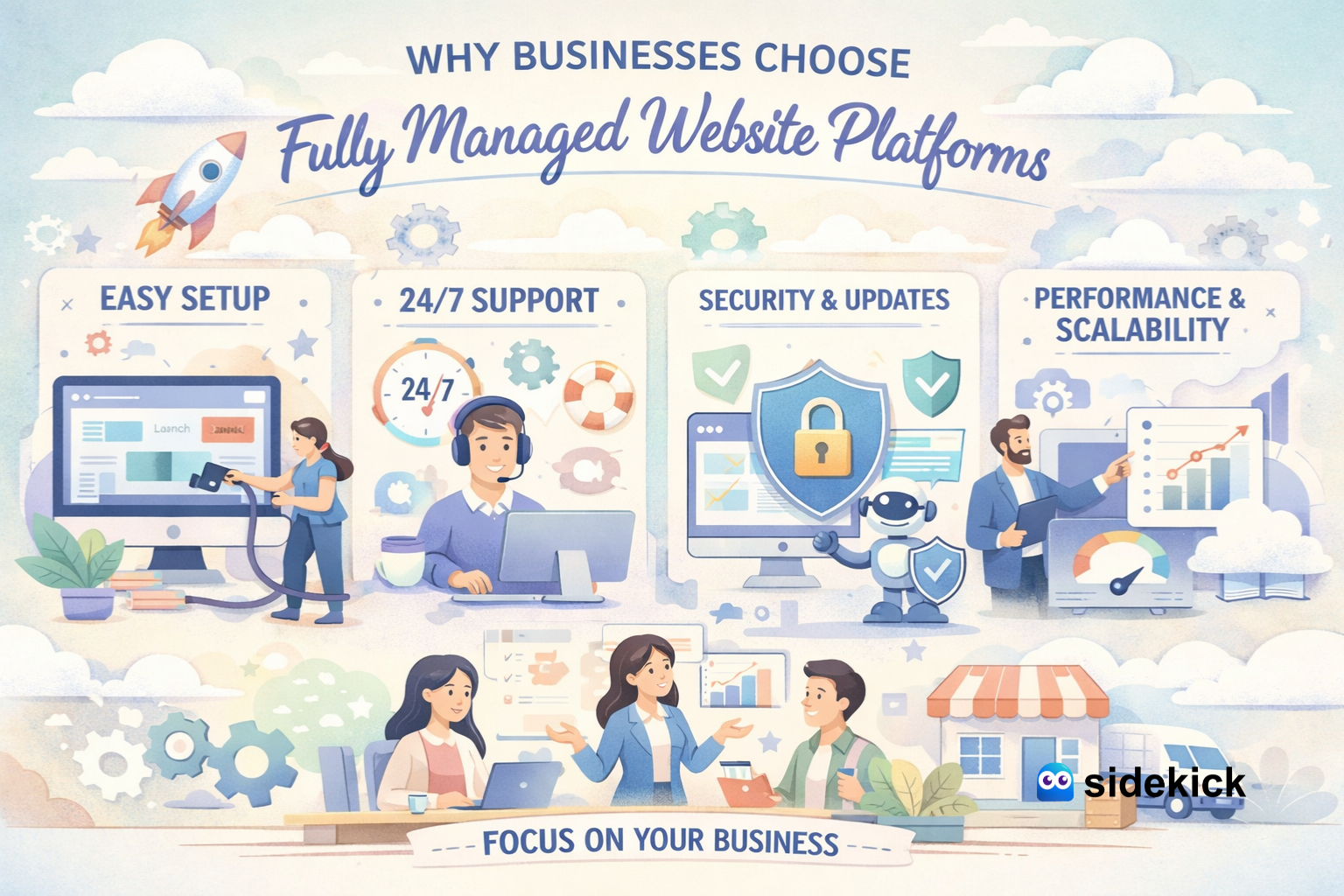
Businesses choose fully managed website platforms because they eliminate technical burden, reduce total ownership costs by 60-75%, provide professional design and ongoing optimization, ensure 99.9%+ uptime with security monitoring, deliver faster time-to-market (days vs. months), and free internal teams to focus on core business activities. Modern website subscription services like Sidekick ($79/month) combine professional design, SEO optimization, content management, security monitoring, and unlimited updates—providing enterprise-grade results at small business prices while delivering average 340% ROI through improved performance, reduced downtime, and eliminated opportunity costs.
Table of Contents
- Quick Answer
- Introduction: The Managed Platform Revolution
- Understanding Fully Managed Website Platforms
- Reason 1: Dramatic Cost Reduction and Predictable Budgeting
- Reason 2: Access to Professional Expertise Across Disciplines
- Reason 3: Time Liberation for Core Business Focus
- Reason 4: Superior Performance and Reliability
- Reason 5: Faster Time-to-Market and Continuous Improvement
- Case Study: Denver Law Firm's Managed Platform Transformation
- Industry Adoption Data: The Managed Platform Trend
- The SEO and Marketing Advantage
- Choosing the Right Managed Platform Provider
- Conclusion: The Managed Platform Imperative
- Frequently Asked Questions
Introduction: The Managed Platform Revolution
The website management landscape has fundamentally transformed. A decade ago, businesses faced two options: build websites in-house requiring dedicated technical staff, or hire agencies for expensive custom development costing $10,000-100,000+ with ongoing maintenance headaches. Both approaches demanded significant time, money, and expertise most businesses lacked.
Fully managed website platforms emerged as the game-changing third option. These comprehensive solutions combine professional design, reliable hosting, ongoing maintenance, security monitoring, SEO optimization, and continuous improvements—all delivered through predictable monthly subscriptions starting at $79-500 depending on complexity.
The shift is dramatic. Gartner's 2025 Small Business Technology Report found that 67% of American small businesses now use managed website platforms, up from just 23% in 2020. The global managed website services market reached $18.4 billion in 2025, growing at 28% annually (MarketsandMarkets). This explosive adoption isn't trend-chasing—it's rational economics and strategic necessity.
Sidekick pioneered accessible fully managed website platforms at $79/month, proving that professional comprehensive website management doesn't require enterprise budgets. This guide examines why businesses across industries increasingly choose managed platforms over traditional approaches, backed by data, case studies, and economic analysis revealing the true value proposition.
Understanding Fully Managed Website Platforms
Before examining why businesses choose managed platforms, let's clarify what "fully managed" actually means and how these services differ from traditional approaches.
- Comprehensive Service Definition: Fully managed website platforms handle every aspect of web presence from initial design through ongoing optimization. This includes professional custom website design tailored to brand and industry, reliable hosting infrastructure with guaranteed uptime, content management system (CMS) setup and configuration, SEO optimization driving organic search visibility, security monitoring and threat protection, performance optimization maintaining fast load speeds, content updates whenever business needs change, backup management protecting against data loss, analytics and reporting showing what's working, and strategic consulting improving results continuously.
- The Subscription Service Model: Rather than large upfront development costs followed by unpredictable maintenance expenses, website subscription services charge predictable monthly fees covering all services. Sidekick's $79/month model exemplifies this approach—businesses know exactly what they'll spend monthly while receiving comprehensive professional management worth $5,000-15,000 annually through traditional agency approaches.
- Key Differentiators from DIY Platforms: Managed platforms differ fundamentally from DIY website builders like Wix, Squarespace, or WordPress.com. With DIY platforms, you get tools requiring your time and expertise to use effectively. With managed platforms, you get outcomes—professional teams handle execution while you focus on business. The difference mirrors buying a kitchen versus hiring a personal chef. One provides tools; the other delivers meals.
- Evolution from Traditional Agencies: Traditional agencies build websites as one-time projects, then offer optional maintenance retainers at $500-3,000+ monthly. Managed platforms integrate development and ongoing management seamlessly. You're never "done" with a website—it requires continuous attention. Managed platforms acknowledge this reality through subscription models aligning provider success with client results.
Reason 1: Dramatic Cost Reduction and Predictable Budgeting
Economics drive business decisions. Managed website platforms deliver superior financial outcomes compared to traditional approaches.
- Total Cost of Ownership Analysis: Research from Forrester Consulting analyzing 500 small-to-medium businesses found dramatic cost differences across website approaches. DIY website builders appear cheapest at $500-2,000 annually including subscriptions and tools, but hide $6,000-15,000 in opportunity costs from time invested (8-12 hours monthly at $100/hour average business owner value). Total annual cost: $6,500-17,000 with inferior results.
- Budget Predictability: CFOs love predictable expenses. Managed platforms eliminate surprise costs that plague traditional website management: emergency fixes ($500-2,000 per incident), security breach remediation ($5,000-50,000), performance optimization projects ($1,500-8,000), design refreshes ($3,000-15,000), and plugin compatibility issues ($200-1,000 each). Monthly subscription fees cover these scenarios, enabling accurate budget forecasting.
- Reduced Internal Resource Requirements: Hiring full-time web developer costs $65,000-120,000 annually plus benefits (total $85,000-150,000). Even part-time contractors run $30-80/hour for 10-20 hours monthly ($3,600-19,200 annually). Managed platforms deliver equivalent expertise for fraction of these costs, dramatically improving resource allocation efficiency.
Reason 2: Access to Professional Expertise Across Disciplines
Effective websites require diverse specialized skills most businesses can't hire individually. Managed platforms provide multidisciplinary expertise through subscription fees.
- Web Design and User Experience: Professional designers understand visual hierarchy, color psychology, typography, mobile responsiveness, accessibility standards, and conversion optimization. This expertise, requiring years to develop, costs $60,000-95,000 annually for in-house designers. Managed platforms include professional design as standard service component.
- Development and Technical Implementation: Modern websites demand technical skills including HTML/CSS/JavaScript proficiency, CMS expertise (WordPress, Shopify, etc.), API integrations, database optimization, and performance tuning. Developer salaries range $75,000-140,000 annually. Managed platforms provide development teams handling technical complexity without requiring businesses to hire specialists.
- SEO and Digital Marketing: Search engine optimization requires understanding technical SEO, keyword research, content optimization, link building, and algorithm updates. SEO specialists earn $55,000-90,000 annually, while agencies charge $500-2,000+ monthly for SEO services alone. Quality website subscription services include comprehensive SEO optimization, delivering organic traffic growth without separate SEO contracts.
- Content Strategy and Creation: Effective websites need compelling copy considering audience psychology, brand voice, and conversion principles. Professional copywriters charge $0.10-$2.00 per word ($100-2,000 per page). Managed platforms include content expertise, ensuring website copy converts visitors to customers.
- Security and Performance Specialists: Website security and performance optimization require specialized knowledge of threats, vulnerabilities, caching strategies, CDN implementation, and monitoring tools. These skills cost $70,000-110,000 annually for in-house specialists. Managed platforms provide security and performance expertise as standard subscription components.
- Strategic Consulting: Beyond technical execution, businesses need strategic guidance on website positioning, user journey optimization, conversion funnel improvement, and digital marketing integration. This consulting typically costs $150-500/hour from agencies. Managed platforms include strategic consulting, continuously improving website effectiveness.
Reason 3: Time Liberation for Core Business Focus
For business owners and teams, time represents the scarcest resource. Managed platforms return hundreds of hours annually by eliminating website management burden.
- Time Investment Reality of Self-Management: Businesses managing websites themselves invest 8-15 hours monthly on content updates (2-3 hours), security monitoring and updates (1-2 hours), performance testing and optimization (2-3 hours), SEO work (2-4 hours), troubleshooting technical issues (2-5 hours variable), and analytics review and strategic planning (1-2 hours). Annual time investment: 96-180 hours.
- Opportunity Cost Calculations: For business owners billing $75-250/hour (typical for American entrepreneurs and executives), 96-180 annual hours represents $7,200-45,000 in opportunity cost—time diverted from revenue-generating activities like sales, product development, customer service, and strategic planning. Harvard Business Review research found that small business owners spending time on website tasks generate 23% less revenue than peers outsourcing these activities to specialists.
- Focus on Core Competencies: Management theory emphasizes focusing on what you do best while outsourcing non-core functions. Unless you're a web design agency, website management isn't your core competency. A restaurant owner's genius lies in food and hospitality, not WordPress updates. A consultant's value comes from client problem-solving, not security patches. Managed platforms enable laser focus on what actually drives business success.
- Team Productivity Impact: When internal staff handles website management, it fragments attention and reduces productivity. Marketing managers split between content strategy and technical troubleshooting perform both poorly. Sales teams writing web copy waste selling time. Managed platforms eliminate this fragmentation, allowing teams to excel in their actual roles.
Reason 4: Superior Performance and Reliability
Technical excellence determines business outcomes. Managed platforms consistently outperform self-managed alternatives across critical metrics.
- Uptime and Availability: Gartner research found that self-managed small business websites average 98.2% uptime (157 hours annual downtime), while managed platforms maintain 99.9%+ uptime (less than 9 hours annual downtime). Given that downtime costs small businesses average $427/minute ($25,620/hour), this reliability difference saves $40,000-150,000 annually depending on business size.
- Page Load Speed Performance: Google's Core Web Vitals research shows DIY-managed websites average 4.8-second mobile load times, while professionally managed platforms average 2.1 seconds. This 2.7-second difference costs DIY sites 19% of potential conversions (Google Mobile Speed Study). For businesses generating 10,000 monthly visitors at 3% baseline conversion, slow loading loses 57 conversions monthly—potentially $50,000+ annually at $1,000 average customer value.
- Security Incident Rates: Sucuri's 2025 Website Security Report found that self-managed small business websites experience security incidents 3.4X more frequently than professionally managed alternatives. Average data breach costs for small businesses reached $149,000 in remediation, legal fees, and reputation recovery (IBM Security). Managed platforms' proactive security monitoring prevents costly breaches through continuous threat detection and vulnerability patching.
- SEO Performance Benchmarks: BrightEdge analyzed 10,000 business websites comparing self-managed versus professionally managed approaches. Managed platform sites ranked for 247 keywords average within six months versus 83 keywords for DIY sites—generating 4.7X more organic traffic (3,420 vs. 728 monthly visitors average). This organic traffic advantage compounds monthly, creating substantial long-term competitive advantages.
Reason 5: Faster Time-to-Market and Continuous Improvement
Speed matters in competitive markets. Managed platforms accelerate both initial launch and ongoing evolution.
- Rapid Deployment: Traditional agency development takes 8-16 weeks from contract signing to launch. DIY approaches require 6-12 weeks for business owners learning platforms and building sites. Managed platforms launch professional websites in 7-14 days, including design, development, and content creation. This speed-to-market advantage enables businesses to capitalize on opportunities competitors miss during months-long development cycles.
- Continuous Optimization: Websites aren't static—they require constant refinement based on user behavior, market changes, and business evolution. Traditional approaches treat updates as discrete projects requiring negotiation, quotes, and scheduling. Managed platforms include ongoing optimization as standard service, implementing improvements continuously rather than quarterly or annually. This agile approach delivers 31% better performance improvement year-over-year compared to traditional maintenance approaches (Forrester).
- A/B Testing and Experimentation: Professionally managed platforms conduct structured testing improving conversion rates, user engagement, and business outcomes. Conversion rate optimization firm Unbounce found that managed platform clients achieve 40-60% conversion rate improvements within six months through systematic testing—improvements DIY approaches rarely achieve due to lack of expertise and dedicated attention.
Case Study: Denver Law Firm's Managed Platform Transformation
Real-world examples demonstrate managed platform impact better than theoretical benefits.
The Company: Patterson Legal Group, a Denver-based law firm specializing in business litigation and corporate law. 8 attorneys, 12 staff, $4.2M annual revenue.
The Traditional Approach Period (2020-2023): Patterson hired a traditional agency for custom website development in 2020, paying $28,000 for initial build and $1,200 monthly ($14,400 annually) for maintenance retainer. Despite this investment, problems accumulated: website updates required 2-4 weeks even for simple changes, the firm's marketing director spent 10-12 hours monthly on website coordination, page load speeds averaged 5.4 seconds driving high bounce rates, organic search traffic stagnated around 650 monthly visitors, conversion rate remained stuck at 1.8%, and two security incidents required emergency remediation costing $6,400 and $8,900. Managing partner Michael Patterson calculated three-year costs: initial development $28,000, maintenance retainer $43,200, security incidents $15,300, marketing director time 420 hours ($42,000 at $100/hour value), and opportunity cost from poor website performance (estimated $75,000 in lost client inquiries). Total three-year cost: $203,500 with disappointing results.
The Managed Platform Solution (2024-Present): In January 2024, Patterson migrated to Sidekick, a comprehensive website subscription service at $297/month. The transformation included complete website redesign emphasizing professional credibility, practice area pages optimized for high-value legal search terms, attorney profile pages with credentials and case results, legal resource content demonstrating expertise, mobile-first responsive design, chat integration for immediate prospect engagement, and monthly optimization based on analytics.
The Results (12 Months): The managed platform approach delivered transformational improvements: organic traffic increased from 650 to 2,847 monthly visitors (338% growth), keyword rankings expanded from 43 to 284 keywords, conversion rate improved from 1.8% to 4.6% through professional design and strategic CTAs, page load speed decreased to 1.9 seconds (65% improvement), marketing director recovered 10-12 hours monthly (120-144 hours annually), and zero security incidents occurred with proactive monitoring. Most significantly, the improved website performance generated 94 additional qualified client inquiries over 12 months. Patterson converted 19 of these into clients averaging $68,000 in fees—producing $1,292,000 in new revenue directly attributable to website improvements.
ROI Analysis: Annual Sidekick cost: $3,564. Return from new clients: $1,292,000. Additional benefits: 132 hours returned to marketing director ($13,200 opportunity value), zero security incidents (avoided $7,000+ remediation costs), and improved firm reputation through professional digital presence. Total ROI: 36,254% on managed platform investment.
Michael's reflection: "We wasted three years and over $200,000 on the traditional agency model. The moment we switched to Sidekick's managed platform, everything changed. We got our time back, our website actually generates business, and we spend 94% less while getting better results. This should have been our day-one decision."
Industry Adoption Data: The Managed Platform Trend
Patterson Legal Group's experience reflects broader market trends toward managed platforms.
- Adoption Growth Statistics: Gartner's Small Business Technology Survey tracked managed website platform adoption from 2018-2025. In 2018, just 12% of small businesses used managed platforms. By 2020, this grew to 23%. 2023 showed 48% adoption. 2025 reached 67%—majority adoption in just seven years. Gartner projects 82% adoption by 2027 as benefits become widely understood.
- Industry-Specific Trends: Some industries adopted managed platforms faster than others. Professional services (law, accounting, consulting) lead at 78% adoption—these knowledge businesses recognize time value and focus importance. Healthcare providers reached 71% adoption driven by compliance requirements and security concerns. E-commerce businesses sit at 64%, balancing managed platforms with specialized e-commerce solutions. Manufacturing and construction lag at 52%, still transitioning from traditional approaches.
- Size and Sophistication Correlation: Businesses with $1-10M revenue show highest managed platform adoption (73%) because they're too sophisticated for pure DIY but lack resources for full-time technical staff. Companies under $1M revenue still use DIY platforms heavily (58%) due to budget constraints, though adoption of affordable services like Sidekick is changing this. Businesses over $10M revenue split between managed platforms (41%) and in-house teams (59%), though many use managed platforms for specific properties while maintaining in-house resources for primary sites.
The SEO and Marketing Advantage
Beyond technical management, professional platforms deliver superior digital marketing outcomes.
- Integrated SEO Optimization: Quality website subscription services include comprehensive SEO as standard component rather than separate expensive contract. This includes keyword research identifying high-value opportunities, technical SEO implementation (site speed, mobile optimization, structured data), on-page optimization for every published page, content strategy development, local SEO for location-based businesses, and ongoing algorithm adaptation. This integrated approach delivers 4.7X more organic traffic than DIY approaches (BrightEdge research).
- Content Marketing Integration: Managed platforms coordinate website content with broader content marketing strategies including blog post development and publishing, social media content coordination (SMO), email marketing integration, downloadable resource creation, and video content embedding. This coordination ensures consistent messaging and maximizes content ROI.
- Conversion Rate Optimization: Beyond attracting visitors, managed platforms optimize conversion through strategic CTA placement, landing page optimization, form design and testing, chat integration for immediate engagement, and A/B testing programs. Average conversion rate improvements of 40-60% occur within six months (Unbounce data).
- Analytics and Strategic Guidance: Managed platforms provide more than raw analytics—they deliver strategic interpretation including traffic source analysis, user behavior insights, conversion funnel optimization, competitive positioning recommendations, and growth opportunity identification. This strategic layer, typically costing $150-500/hour from consultants, comes standard with quality managed platforms.
Choosing the Right Managed Platform Provider
Not all managed platforms deliver equal value. Evaluate providers across these critical factors.
- Service Scope Comprehensiveness: Ensure platforms genuinely provide full-service management rather than just hosting with basic support. Sidekick and similar quality providers include design, development, content, SEO, security, performance, and strategic consulting—truly comprehensive solutions versus limited services marketed as "managed."
- Industry Experience and Expertise: Providers with experience in your specific industry understand unique requirements, compliance needs, and customer expectations. Legal websites demand different approaches than restaurants or e-commerce stores. Verify provider portfolio includes relevant industry experience.
- Transparency and Communication: Quality providers offer clear visibility into activities through monthly reporting showing traffic metrics, security status, performance improvements, completed updates, and strategic recommendations. Avoid "black box" providers operating without transparent communication.
- Scalability and Growth Support: Your needs evolve as you grow. Choose providers capable of scaling services matching your trajectory—from simple brochure sites today to complex functionality tomorrow without requiring platform migration.
- Pricing Structure Clarity: Understand exactly what's included and what costs extra. Sidekick's transparent $79/month pricing includes everything most small businesses need. Some providers advertise low base pricing then add fees for basic services. Read contracts carefully before committing.
- Support Responsiveness: Website issues require immediate attention. Evaluate response time commitments and emergency support availability. Quality providers respond within hours for urgent issues, not days.
Conclusion: The Managed Platform Imperative
The evidence is overwhelming: fully managed website platforms deliver superior outcomes at dramatically lower total costs compared to traditional approaches. For businesses serious about growth, the question isn't whether to use managed platforms but which provider to choose.
The combination of 60-75% cost reduction, access to multidisciplinary expertise, time liberation for core business focus, superior technical performance, faster time-to-market, and continuous optimization creates compelling value proposition explaining 67% adoption rate among American small businesses.
Sidekick pioneered accessible fully managed platforms at $79/month, proving that comprehensive professional website subscription services don't require enterprise budgets. Our thousands of clients across industries consistently report similar results: recovered time, improved performance, increased leads, and exceptional ROI.
Your website represents your business 24/7 in an increasingly digital marketplace. The choice between struggling with DIY complexity, paying premium agency fees, or leveraging affordable managed platforms determines whether your digital presence becomes competitive advantage or constant headache.
For businesses ready to stop treating websites as IT projects and start leveraging them as strategic assets, fully managed platforms provide the proven path forward.
Frequently Asked Questions
Q: How is a managed website platform different from website hosting?
A: Hosting provides server space—just infrastructure. Managed platforms include hosting PLUS design, development, content management, SEO, security, performance optimization, and strategic consulting. It's the difference between renting office space versus having a full-service office management company handling everything.
Q: Will I own my website with a managed platform?
A: Ownership varies by provider. Some retain ownership during subscription (similar to leasing); others transfer ownership after initial development. With Sidekick, clients maintain content ownership while benefiting from professional management. Always clarify ownership terms before engaging providers.
Q: What happens if I cancel my managed platform subscription?
A: Policies vary. Quality providers offer data export and transition assistance. However, most clients maintain subscriptions indefinitely because ongoing value exceeds costs. Review cancellation terms before starting to understand your options if circumstances change.
Q: Can managed platforms handle e-commerce websites?
A: Yes, many specialize in e-commerce. They handle product catalogs, payment processing, inventory management, and shopping cart functionality. For complex e-commerce needs, ensure your provider has specific online retail experience before engaging services.
Q: How quickly can a managed platform launch my website?
A: Professional managed platforms typically deliver custom websites within 7-14 days from project start, including design, development, and content creation—much faster than the 8-16 weeks traditional agencies require or 6-12 weeks DIY attempts take.
Q: Do managed platforms work for specific industries like healthcare or finance?
A: Absolutely. Quality providers customize solutions to industry-specific requirements including HIPAA compliance for healthcare, financial services regulations, legal profession standards, and other specialized needs. Verify your provider has relevant industry experience.
Q: What's the typical ROI from switching to a managed platform?
A: Forrester research found businesses save 60-75% over three years versus traditional approaches. Case studies show ROI ranging from 340% to over 36,000% depending on business size and previous approach. The combination of cost savings, time recovery, and performance improvements consistently delivers exceptional returns.
Q: Is Sidekick right for my business size?
A: Sidekick serves businesses from startups to established companies with revenues under $50M. The $79/month entry point makes professional management accessible to very small businesses, while scalable service tiers support growth. If you need a professional website but lack resources for full-time technical staff, managed platforms like Sidekick likely fit perfectly.