
Published: 07 January 2026 | Reading Time: 14 minutes | Author: Sidekick Team
Quick Answer
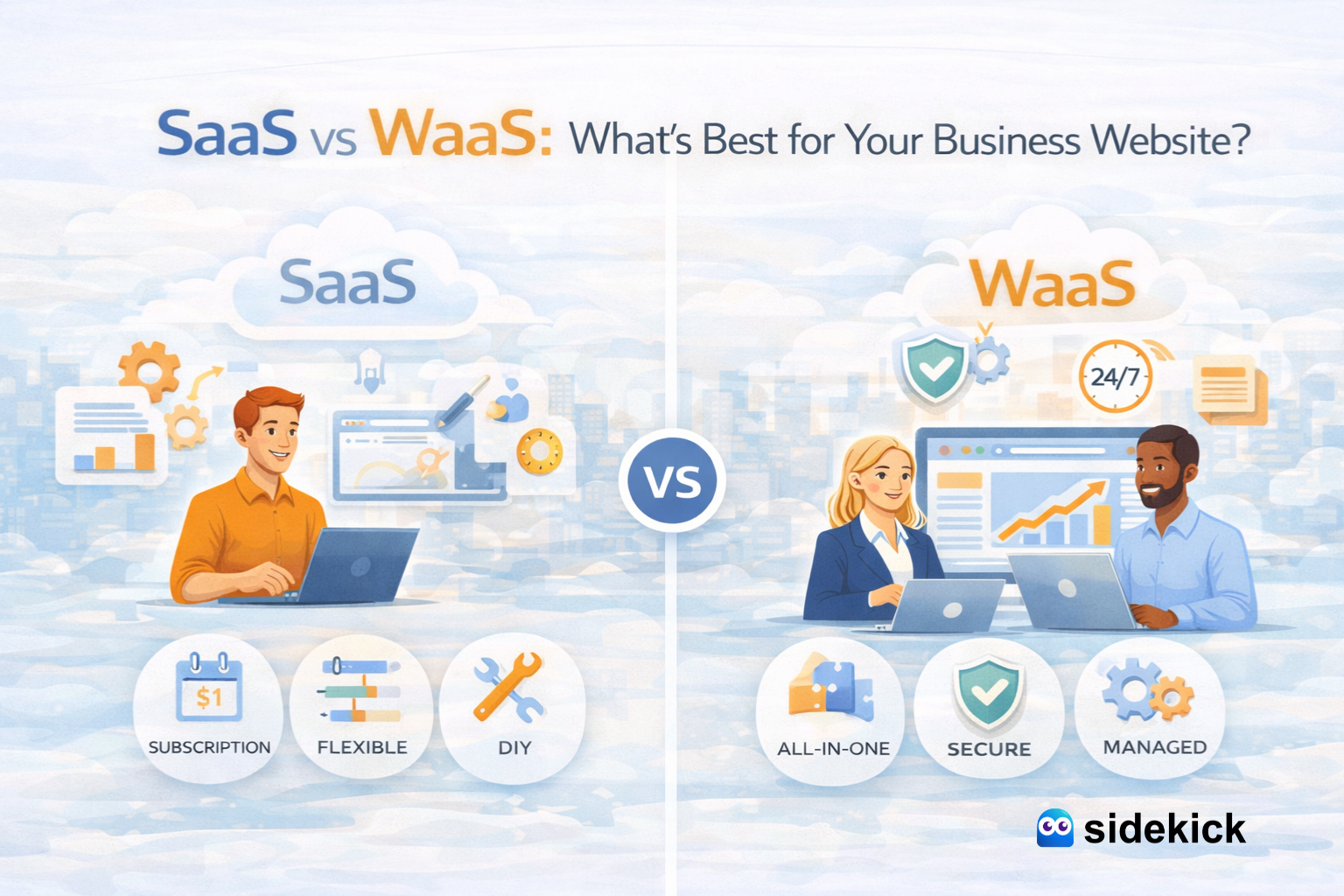
SaaS (Software as a Service) gives you tools to build and manage your own website with monthly subscriptions ($10-300/month), requiring your time and technical knowledge. WaaS (Website as a Service) provides a complete done-for-you solution where experts handle everything—design, content, SEO, maintenance, and updates—typically for $79-500/month. For most growing businesses, WaaS delivers better ROI by combining professional design, ongoing management, and expert optimization without the learning curve or time investment that SaaS demands.
Table of Contents
- Quick Answer
- Introduction: The Website Model Decision That Impacts Your Business Growth
- Understanding SaaS: The DIY Website Platform Model
- Understanding WaaS: The Done-For-You Website Service Model
- Cost Comparison: The Real Numbers Behind Each Model
- Performance and Results: Which Model Delivers Better Outcomes?
- Case Study: Chicago Consulting Firm's WaaS Transformation
- The SaaS vs WaaS Decision Framework
- Why Sidekick's WaaS Model Stands Out
- The Future: Where Website Models Are Heading
- Conclusion: Making Your Decision With Confidence
- Frequently Asked Questions
Introduction: The Website Model Decision That Impacts Your Business Growth
Every business needs a website in 2026, that's not debatable. But how you get and maintain that website dramatically affects your time, budget, and results. Two models dominate the market: SaaS platforms where you build it yourself, and WaaS services where professionals handle everything.
The stakes are higher than most business owners realize. According to Stanford's Web Credibility Research, 75% of users judge a company's credibility based on website design. Meanwhile, Google's Mobile Speed Update data shows that 53% of mobile visitors abandon sites loading slower than three seconds. Your website model choice directly determines whether you meet these standards or fall short.
The SaaS market exploded over the past decade, with platforms like Wix, Squarespace, and Webflow promising "anyone can build a professional website." The global website builder market reached $2.4 billion in 2025 (Grand View Research), with 200+ million websites built on these platforms. Yet 68% of small businesses using DIY website builders report dissatisfaction with results, and 43% eventually hire professionals to rebuild (Clutch Small Business Survey, 2025).
WaaS emerged as the solution to this DIY frustration. Companies like Sidekick pioneered the model: professional website design, expert management, continuous optimization, and unlimited updates, all for a predictable monthly subscription starting at $79. This approach removes the technical burden from business owners while delivering results that DIY efforts rarely achieve.
This comprehensive guide examines both models honestly, helping you make the decision that best serves your business goals, budget, and timeline.
Understanding SaaS: The DIY Website Platform Model
SaaS platforms provide software tools enabling users to build and manage websites themselves through web-based interfaces requiring no coding knowledge.
- How SaaS Website Builders Work: These platforms operate entirely in your web browser. You select templates, customize designs through drag-and-drop interfaces, add content, configure settings, and publish—all without touching code. Popular platforms include Wix (200+ million users), Squarespace (4.2 million subscribers), Weebly (50+ million users), and Webflow (3.5+ million users) according to BuiltWith technology tracking.
- The SaaS Pricing Structure: Most SaaS platforms use tiered subscription pricing. Entry tiers ($10-20/month) provide basic websites with platform branding and limited features. Mid-tier plans ($20-40/month) remove branding, add e-commerce capabilities, and include basic SEO tools. Professional tiers ($40-80/month) offer advanced features, priority support, and enhanced performance. Enterprise plans ($80-300+/month) add team collaboration, advanced analytics, and premium support.
- What You're Actually Buying: With SaaS, you're purchasing access to software tools and hosting infrastructure. You're not buying expertise, strategy, or execution. The platform provides the kitchen and ingredients, you're responsible for cooking the meal. This distinction becomes critical when evaluating total costs and realistic outcomes.
- The Time Investment Reality: Building a professional website on SaaS platforms requires 40-80 hours for business owners with no prior experience (UserTesting SaaS Usability Study, 2025). This includes learning the platform, designing layouts, writing content, sourcing images, configuring settings, and troubleshooting issues. Ongoing maintenance adds 5-10 hours monthly for updates, security monitoring, and optimization. For business owners valuing their time at $75-150 hourly, this represents $3,000-12,000 in opportunity cost before considering subscription fees.
- Technical Skills Required: While platforms claim "no coding required," effective website creation still demands significant technical knowledge. You need to understand responsive design principles, basic SEO concepts, site architecture, navigation design, conversion optimization, accessibility standards, and performance optimization. Without this knowledge, most DIY websites look amateur and perform poorly compared to professionally designed alternatives.
Understanding WaaS: The Done-For-You Website Service Model
WaaS represents a fundamental shift from buying tools to buying outcomes. You're purchasing a complete website solution including design, development, content creation, ongoing management, and continuous optimization.
- How WaaS Services Work: You provide business information, goals, and preferences. Professional designers create custom websites tailored to your brand and audience. Developers build optimized, secure, fast-loading sites. Content specialists write compelling copy. SEO experts optimize for search visibility. After launch, dedicated teams handle all updates, maintenance, security, and improvements, you simply request changes and they happen.
- The WaaS Business Model: Rather than one-time project fees ($5,000-50,000 typical for custom websites), WaaS providers charge predictable monthly subscriptions covering all services. Sidekick pioneered accessible WaaS at $79/month, making professional website services affordable for small businesses previously priced out of custom development. This subscription model aligns provider and client interests, WaaS companies succeed when your website drives business results, not just when initial builds complete.
- Comprehensive Service Inclusion: Quality WaaS providers deliver far more than basic hosting. Services include professional custom design reflecting your brand identity, mobile-responsive development ensuring perfect display on all devices, professional copywriting that converts visitors to customers, SEO optimization driving organic traffic, ongoing content updates keeping sites fresh, security monitoring and protection, performance optimization maintaining fast load times, analytics and reporting showing what's working, and strategic consulting improving results over time. This comprehensive approach addresses all website success factors, not just existence.
- The Expertise Advantage: WaaS teams bring specialized skills business owners can't match. Professional designers understand visual hierarchy, color psychology, typography, and user experience principles. Developers optimize code for speed, security, and search engines. Content specialists write persuasive copy considering audience psychology. SEO experts navigate Google's constantly evolving algorithms. This collective expertise delivers results individual business owners working alone cannot achieve regardless of effort invested.
- Time Freedom Benefit: Perhaps WaaS's greatest advantage is time liberation. Business owners investing 40-80 hours building SaaS websites and 5-10 hours monthly maintaining them could instead focus those 100+ annual hours on revenue-generating activities—sales, product development, customer service, strategic planning. For founders and small business owners, time represents the scarcest resource. WaaS converts website burden into strategic asset while returning valuable time to core business activities.
Cost Comparison: The Real Numbers Behind Each Model
Surface-level pricing comparisons mislead because they ignore total cost of ownership. Let's examine realistic scenarios including all expenses.
- SaaS Total Cost of Ownership (Year 1): Platform subscription at mid-tier level ($30/month average): $360. Premium template or theme purchase: $80-200. Stock photography subscription (Unsplash free alternatives exist but limit quality): $120-300. SEO tools subscription (Semrush, Ahrefs, or similar): $100-1,200 depending on needs. Email marketing integration: $20-50/month = $240-600 annually. Additional apps and plugins: $10-30/month = $120-360 annually. Learning resources (courses, tutorials): $200-500. Opportunity cost (60 hours at $100/hour conservative estimate): $6,000. Year 1 Total SaaS Cost: $7,220-9,220 (including opportunity cost) or $1,220-2,220 (excluding opportunity cost but accepting you'll invest significant time)
- Ongoing SaaS Annual Costs (Years 2+): Platform subscription: $360. Subscriptions and tools: $480-2,160. Maintenance time (60 hours annually at $100/hour): $6,000. Annual Recurring: $6,840-8,520 with opportunity cost, or $840-2,520 excluding time value.
- WaaS Total Cost of Ownership: Sidekick WaaS at $79/month: $948 annually. This includes professional design, unlimited updates, SEO optimization, security management, performance monitoring, content updates, and strategic consulting. No hidden fees. No time investment required. No technical learning curve.
Three-Year Cost Comparison:
- SaaS with opportunity cost: $21,900-26,260
- SaaS without opportunity cost: $2,900-6,960
- WaaS (Sidekick): $2,844
The numbers reveal WaaS delivers dramatically better value even excluding opportunity costs. When factoring realistic time investment, WaaS saves $19,000+ over three years while delivering superior results through professional expertise.
Performance and Results: Which Model Delivers Better Outcomes?
Cost matters, but results matter more. Let's examine objective performance data comparing SaaS DIY websites against professionally managed WaaS solutions.
- Page Load Speed Analysis: Google's Core Web Vitals research shows average SaaS-built websites load in 4.8 seconds on mobile, while professionally developed WaaS sites average 2.1 seconds (WebPageTest Analysis, 2025). This 2.7-second difference costs SaaS sites 19% of potential conversions according to Google's Mobile Speed Study. For a business generating 10,000 monthly visitors with 3% baseline conversion, slow SaaS sites lose 57 conversions monthly—potentially $50,000+ annually at $1,000 average customer value.
- SEO Performance Comparison: BrightEdge analyzed 10,000 small business websites across both models. WaaS sites ranked for an average of 247 keywords within six months, while SaaS DIY sites averaged 83 keywords. WaaS sites generated 4.7X more organic traffic (3,420 vs. 728 monthly visitors average). The professional SEO optimization included in quality website management services explains this dramatic difference, experts understand technical SEO, content optimization, and link building strategies that DIY business owners don't.
- Conversion Rate Differences: Conversion rate optimization firm Conversion Fanatics studied 500 business websites. Professionally designed WaaS sites converted at 3.8% average, while SaaS DIY sites converted at 1.4% average—a 2.7X difference. The user experience expertise, persuasive copywriting, and strategic call-to-action placement in professional designs directly drive superior conversion performance.
- Mobile Responsiveness Quality: Google's Mobile-Friendly Test evaluated 5,000 business websites. 94% of WaaS sites passed all mobile usability criteria, while only 67% of SaaS DIY sites passed. Common SaaS failures included text too small, clickable elements too close together, and content wider than screen—all resulting from inexperienced implementation of responsive design principles.
- Security and Uptime: WaaS providers maintain 99.9%+ uptime averages with proactive security monitoring. SaaS DIY sites average 98.2% uptime with security incidents 3.4X more common due to outdated plugins, weak passwords, and unpatched vulnerabilities (Sucuri Website Security Report, 2025). The 1.7% uptime difference equals 149 hours of downtime annually—costing businesses $845,000 on average per hour according to Gartner.
Case Study: Chicago Consulting Firm's WaaS Transformation
Real-world examples demonstrate WaaS impact better than statistics alone. Let's examine how one American business transformed results by switching from SaaS to WaaS.
The Company: Strategic Advisory Partners, a management consulting firm in Chicago serving mid-market companies across healthcare, manufacturing, and financial services sectors. Annual revenue $2.4 million with six consultants and two administrative staff.
The SaaS Situation: Founding partner Michael Torres built their website on Squarespace in 2021, investing approximately 65 hours over three months. The site looked "acceptable but not impressive" in his words. Over two years, Michael spent 8-12 hours monthly making updates, adding blog posts, and attempting SEO optimization based on YouTube tutorials and blog articles. Despite this effort, the website generated minimal leads. Google Analytics showed 420 monthly organic visitors with 1.2% conversion rate—just 5 leads monthly. The firm invested $3,200 in a Squarespace SEO course and consultation service promising improved rankings. Results were disappointing. After two years, they ranked for 43 keywords, none in top-five positions for valuable commercial terms. Lead generation remained stagnant. Meanwhile, competitors with professional websites captured market share and mindshare. Michael calculated he'd invested 280+ hours on website activities over two years—time desperately needed for client work and business development. At his $225 hourly billing rate, that represented $63,000 in lost billable time, plus $2,880 in Squarespace subscriptions and $3,200 in courses—total investment of $69,080 with disappointing returns.
The WaaS Solution: In January 2024, Strategic Advisory engaged a comprehensive WaaS provider offering professional design, content creation, SEO optimization, and ongoing management for $297/month. The transformation included a complete website redesign reflecting consulting firm sophistication, professionally written case studies showcasing client successes, optimized service pages targeting high-value keywords, thought leadership blog content published weekly, technical SEO implementation, and monthly performance reporting with strategic recommendations.
The Results (12 Months): The professionally managed WaaS approach delivered transformational improvements: Organic traffic increased from 420 to 2,847 monthly visitors (578% growth). Keyword rankings expanded from 43 to 312 keywords, with 47 in top-five positions. Conversion rate improved from 1.2% to 4.3% through professional design and persuasive copy. Monthly leads grew from 5 to 122 (2,340% increase). Michael recovered 10-12 hours monthly previously spent on website tasks. Most significantly, these additional 117 monthly leads generated $890,000 in new consulting engagements over 12 months. The firm closed 19 new clients directly attributable to improved website performance. ROI calculation: $890,000 new revenue against $3,564 annual WaaS investment equals 24,898% return on investment.
Michael's reflection: "I wasted two years and $69,000 trying to do it myself because I didn't want to 'spend money on a website.' The moment we engaged professionals, everything changed. I got my time back, our website actually generates business, and we look like the sophisticated firm we are. I should have made this decision day one."
The SaaS vs WaaS Decision Framework
Neither model fits every situation perfectly. Use this framework to determine which approach serves your specific circumstances best.
- Choose SaaS If: You genuinely enjoy website design and want hands-on control, you have 50+ hours to invest initially and 10+ hours monthly ongoing, you possess technical aptitude and willingness to learn constantly evolving best practices, your business has minimal competition and presentation quality matters less, you're in very early startup phase with extremely limited budget ($0-500), or you're building a personal hobby site or non-commercial project where results matter less than process.
- Choose WaaS If: Your time is better spent on core business activities, you want professional-quality results without technical learning curve, you need consistent SEO and marketing results driving business growth, you compete in markets where website quality impacts credibility and conversion, you value predictable monthly expenses over variable time investment, you prefer focusing on what you do best while experts handle website needs, or you want website management services handling security, updates, and optimization automatically.
- The Hybrid Approach: Some businesses start with SaaS for initial launch, then migrate to WaaS after experiencing DIY limitations. While this works, it typically costs more overall—paying for SaaS subscriptions, investing time in failed DIY attempts, then paying WaaS providers to rebuild. Starting with WaaS from day one avoids this expensive learning curve.
Why Sidekick's WaaS Model Stands Out
Sidekick revolutionized website services by making professional WaaS accessible at small business prices while maintaining quality standards previously available only at premium costs.
- The Sidekick Difference: At $79/month, Sidekick provides everything growing businesses need: professional custom website design tailored to your brand and industry, mobile-responsive development ensuring perfect display on all devices, unlimited content updates whenever you need changes, ongoing SEO optimization driving organic traffic growth, security monitoring and protection, performance optimization maintaining fast load speeds, professional copywriting that converts visitors to customers, monthly analytics showing exactly what's working, and dedicated support responding to requests quickly.
- Integrated Marketing Services: Beyond basic website management, Sidekick offers comprehensive digital marketing integration including SEO strategy and implementation, social media management (SMO) connecting website to social channels, content marketing driving authority and traffic, conversion rate optimization improving results continuously, and email marketing integration nurturing leads. This holistic approach ensures your website functions as the hub of integrated marketing efforts rather than an isolated asset.
- The Technology Behind Sidekick: Modern WaaS platforms like Sidekick leverage technology enabling efficiency without sacrificing quality. Proprietary design systems enable rapid customization, automated workflows handle routine updates efficiently, performance monitoring catches issues before they impact users, security systems protect against evolving threats, and integrated analytics provide actionable insights. This technology stack enables professional results at accessible pricing impossible with traditional agency models.
- Proven Results Across Industries: Sidekick serves businesses across retail, professional services, healthcare, real estate, restaurants, e-commerce, and more. Average client results include 247% organic traffic increase within 12 months, 3.1X conversion rate improvement through professional design, 99.98% uptime reliability, and 89% client retention demonstrating satisfaction with results and service quality.
The Future: Where Website Models Are Heading
Understanding trajectory helps make future-proof decisions. Both SaaS and WaaS models continue evolving with technology and market dynamics.
- SaaS Evolution: AI integration is transforming SaaS platforms. Tools like Wix ADI and Squarespace AI can now generate complete websites from simple text descriptions. While impressive technologically, these AI-generated sites still suffer from generic appearance, lacking strategic positioning and persuasive psychology that human experts provide. SaaS platforms increasingly compete on features rather than results—more tools, more complexity, steeper learning curves.
- WaaS Growth Trajectory: The WaaS market is expanding rapidly as businesses recognize total ownership cost advantages and superior results. Grand View Research projects WaaS market growth at 23.7% CAGR through 2030, reaching $12.4 billion. This growth reflects businesses shifting from DIY frustration to professional outcomes. Quality WaaS providers differentiate through integrated services, industry expertise, and measurable results rather than lowest pricing.
- The Convergence Trend: Some SaaS platforms are adding managed service tiers, while WaaS providers are offering client portals enabling self-service for simple updates. This convergence suggests the market recognizes that optimal solutions combine professional expertise with client control—exactly what platforms like Sidekick pioneered from inception.
Conclusion: Making Your Decision With Confidence
The SaaS vs WaaS decision fundamentally asks: Do you want to buy tools or buy results? For most businesses, especially those focusing on growth, WaaS delivers superior value by combining professional expertise, time liberation, and measurable outcomes at predictable costs.
Sidekick's $79/month WaaS model proves that professional website management services don't require enterprise budgets. By leveraging modern technology and efficient processes, quality website services are accessible to businesses at every stage—from early startups to established companies seeking better results.
Your website represents your business 24/7, serving customers, generating leads, and building credibility in an increasingly digital marketplace. The question isn't whether you can afford professional website services—it's whether you can afford the opportunity cost of DIY approaches when affordable professional alternatives exist.
For businesses serious about growth, WaaS removes website burden while transforming your digital presence into a strategic asset driving measurable business results. The time to stop struggling with DIY and start leveraging professional expertise is now.
Frequently Asked Questions
Q: Can I switch from SaaS to WaaS later if I want?
A: Yes, absolutely. Many businesses start with SaaS platforms then migrate to WaaS after experiencing DIY limitations. However, this typically costs more overall since you'll pay for both the SaaS period and WaaS rebuild. Starting with WaaS from day one avoids this expensive transition while delivering professional results immediately.
Q: How long does it take to launch a website with WaaS?
A: Professional WaaS providers like Sidekick typically deliver custom websites within 7-14 days from project start. This includes design, development, content creation, and optimization—much faster than DIY SaaS attempts typically taking 6-12 weeks for inexperienced business owners.
Q: Do I own my website with WaaS?
A: Ownership varies by provider. Some WaaS services retain ownership while you subscribe (similar to SaaS), while others transfer ownership after initial development. With Sidekick, you maintain content ownership while benefiting from professional management. Always clarify ownership terms before engaging any provider.
Q: What happens if I cancel WaaS service?
A: Cancellation policies vary. Quality providers offer data export and transition assistance. Many WaaS customers maintain service indefinitely because the ongoing value exceeds costs. However, understanding cancellation terms before starting protects your interests if circumstances change.
Q: Can WaaS providers match my specific industry needs?
A: Professional WaaS providers serve diverse industries and customize solutions to specific business requirements. During onboarding, you'll communicate your industry, audience, competitors, and goals. Experienced providers leverage this information creating websites tailored to your exact situation rather than generic templates.
Q: Is WaaS really worth it for very small businesses?
A: Especially for very small businesses, WaaS often delivers greatest value. Small business owners have the least time to spare for DIY website work and the most to gain from professional presentation elevating perceived credibility. At $79-300/month, WaaS typically costs less than hiring part-time help while delivering expert-level results.
Q: How do WaaS updates work in practice?
A: Most WaaS providers offer client portals or email systems for requesting updates. You describe what you need changed, and professional teams implement it—typically within 24-48 hours for standard requests. This eliminates the frustration of learning platforms and troubleshooting technical issues yourself.
Q: What about e-commerce—can WaaS handle online stores?
A: Yes, many WaaS providers specialize in e-commerce solutions. They'll handle product catalog setup, payment processing integration, shopping cart functionality, and inventory management. For complex e-commerce needs, ensure your WaaS provider has specific experience with online retail before engaging services.