
Published: 06 January 2026 | Reading Time: 12 minutes | Author: Sidekick Team
Quick Answer
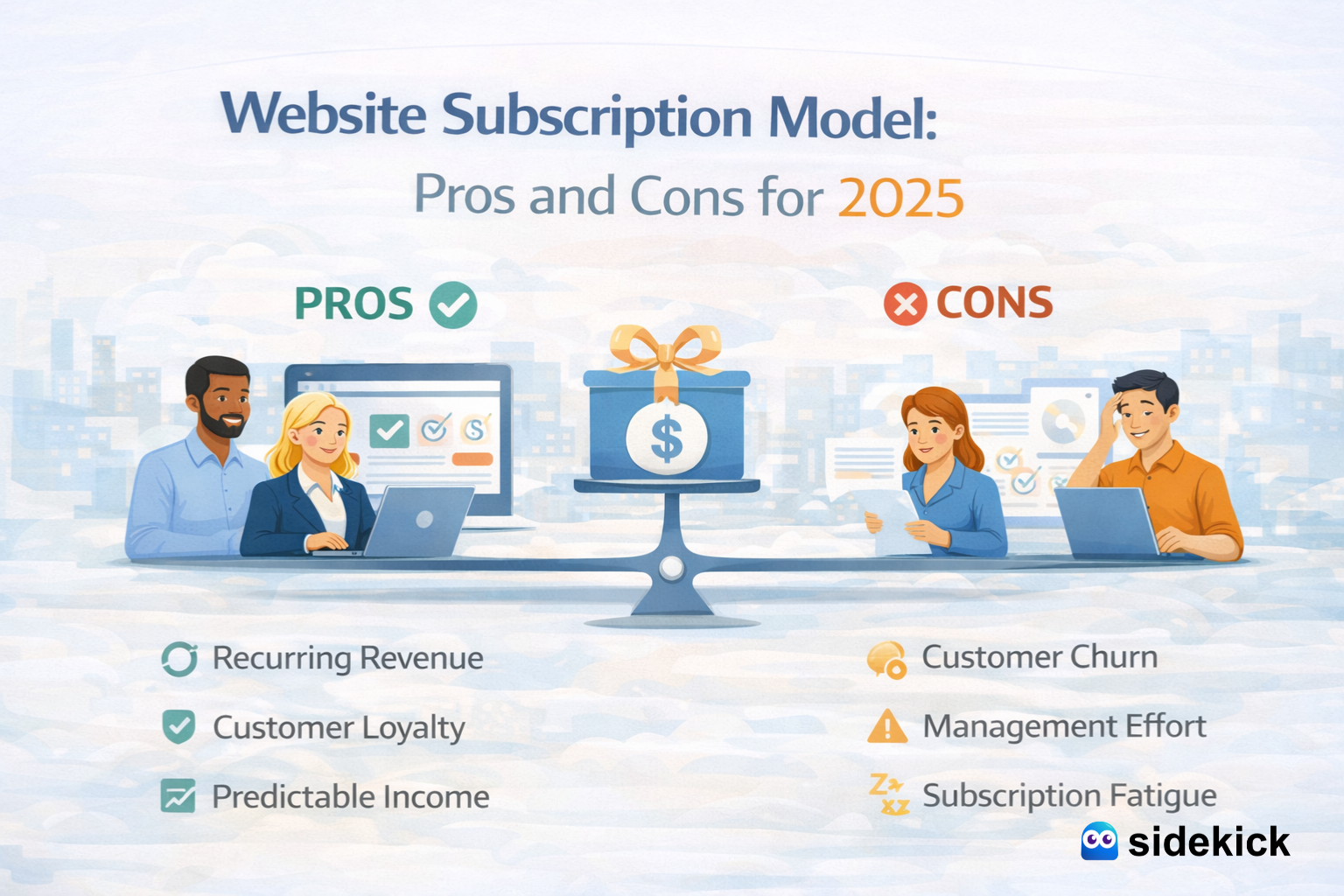
Website subscription models offer businesses predictable monthly costs ($79-$500/month typically) instead of large upfront expenses ($5,000-$50,000), plus ongoing maintenance, security, and updates. Pros include affordability, continuous support, and scalability. Cons include long-term costs potentially exceeding one-time builds, vendor lock-in, and customization limitations. For 2025, 67% of small businesses prefer subscription models due to cash flow benefits and included website management services, making it the dominant approach for companies under $10M revenue.
Table of Contents
- Quick Answer
- Introduction: The Shift from Ownership to Subscription
- Understanding Website Subscription Models
- The Pros: Why Subscriptions Are Winning
- The Cons: Understanding the Limitations
- Case Study: Austin SaaS Company's Subscription Journey
- Market Data: Subscription Adoption Growth Chart
- Strategic Considerations: Choosing the Right Model
- The Future: Where Subscriptions Are Heading
- Conclusion: The Right Model for Your Business
Quick Answer
Website subscription models offer businesses predictable monthly costs ($79-$500/month typically) instead of large upfront expenses ($5,000-$50,000), plus ongoing maintenance, security, and updates. Pros include affordability, continuous support, and scalability. Cons include long-term costs potentially exceeding one-time builds, vendor lock-in, and customization limitations. For 2025, 67% of small businesses prefer subscription models due to cash flow benefits and included website management services, making it the dominant approach for companies under $10M revenue.
Introduction: The Shift from Ownership to Subscription
Remember when you bought software in a box? Microsoft Office 2003 cost $499 one time, and you owned it forever. Today, Microsoft 365 costs $99.99 annually, and you never truly "own" it. This same transformation is reshaping how American businesses acquire and maintain websites.
The traditional website model worked like buying a house: pay $10,000-$50,000 upfront, own it completely, then handle all maintenance yourself. The subscription model resembles renting an apartment: pay $79-$500 monthly, maintenance included, flexibility to upgrade or downgrade as needs change.
According to Gartner's 2025 Digital Infrastructure Report, 64% of small businesses now use subscription-based website management services compared to just 23% in 2020. The SaaS (Software as a Service) revolution that transformed business software is now transforming websites themselves. This shift fundamentally changes how American companies budget for, maintain, and think about their digital presence.
Sidekick pioneered affordable website subscriptions at just $79/month, proving that small businesses don't need five-figure budgets to maintain professional, secure, high-performing websites. But is the subscription model right for every business? Let's examine the complete picture with real data, case studies, and honest analysis of both benefits and drawbacks.
Understanding Website Subscription Models
Website subscription services bundle everything needed for online presence into predictable monthly payments. Let's break down what you actually get compared to traditional one-time purchases.
- What's Typically Included: Most subscription services provide website design and initial build, responsive mobile optimization, domain name and SSL certificate, reliable hosting infrastructure, ongoing security monitoring and updates, regular content updates and changes, technical support and troubleshooting, SEO optimization and maintenance, and performance monitoring and improvements. Traditional one-time website purchases include only initial design and development—everything else costs extra or requires DIY management.
- Pricing Tiers in 2025: The American market shows clear pricing segments. Budget tier ($50-$150/month) includes basic websites with 5-10 pages, standard templates, limited customization, monthly content updates, and basic hosting. Mid-tier ($150-$500/month) offers custom designs, 10-25 pages, advanced features like e-commerce or booking systems, weekly updates, premium hosting, and comprehensive SEO. Premium tier ($500-$2,000/month) delivers fully custom platforms, unlimited pages and features, daily monitoring and updates, dedicated account management, and enterprise-grade security and performance.
- The SaaS Industry Parallel: Website subscriptions follow the proven SaaS business model that transformed software. Adobe shifted from selling Photoshop for $699 to Creative Cloud at $54.99/month. Salesforce built a $280 billion company on subscription CRM. QuickBooks moved from $299 one-time to $30/month. According to Zuora's Subscription Economy Index, companies using subscription models grow revenue 5.5 times faster than traditional businesses. Website subscriptions apply this successful model to digital presence, with similar benefits for both providers and customers.
The Pros: Why Subscriptions Are Winning
The subscription model offers compelling advantages explaining why adoption grew from 23% to 64% among small businesses in just five years.
- Dramatically Lower Barrier to Entry: Traditional website development costs $5,000-$50,000 upfront depending on complexity. For startups and small businesses, this represents a significant capital expense requiring approval, financing, or delayed launch. Subscription models reduce initial investment to first month's payment—$79-$500 versus thousands. This 95% reduction in upfront cost means businesses launch professional websites immediately rather than saving for months or settling for DIY platforms like Wix or Squarespace that lack professional quality.
- Continuous Professional Management: Traditional websites suffer from neglect. Businesses pay for initial development, then lack budget or expertise for ongoing maintenance. Security vulnerabilities go unpatched. Content grows stale. Performance degrades. According to Sucuri's 2025 Website Security Report, 73% of small business websites have at least one serious security vulnerability, primarily because owners don't maintain them. Subscription models include ongoing website management services as core value.
- Predictable Budgeting: CFOs love subscription models because they convert unpredictable capital expenses into predictable operational expenses. Budgeting becomes difficult when website costs might be $15,000 one year, $800 another year, then $8,000 for a refresh. Subscriptions provide perfect predictability: $79, $150, or $500 monthly, indefinitely. No surprise expenses. No emergency repair bills. Deloitte's 2025 CFO Survey found that 71% of financial executives prefer subscription models over capital purchases when quality and functionality are equivalent.
- Built-in Scalability and Flexibility: Business needs change rapidly. Traditional websites require expensive redesign projects costing $8,000-$25,000 to upgrade significantly. You're locked into your initial purchase until you can afford another major project. Subscription models offer flexible scaling. Start with basic tier at $79/month, upgrade to mid-tier at $200/month when adding e-commerce, jump to premium at $500/month as enterprise features become necessary. Changes happen smoothly within your subscription.
- Risk Reduction and Trial Ability: Paying $15,000 for a website represents significant risk. Subscription models reduce risk dramatically. Don't like the service? Cancel after a month with minimal loss. Business pivoting? Transition quickly without abandoning major investment. This low-risk trial ability accelerates decision-making. According to Harvard Business Review research, reducing decision friction increases business agility 34% on average—valuable in fast-moving markets.
The Cons: Understanding the Limitations
Honesty requires acknowledging subscription models aren't optimal for every business or situation. Real drawbacks exist that influence which model suits specific circumstances.
- Long-Term Cost Can Exceed One-Time Purchase: Simple math reveals that subscriptions cost more over time. A $79/month subscription costs $948 annually, $4,740 over five years, $9,480 over ten years. A one-time $5,000 website purchase costs exactly $5,000 regardless of how long you keep it. However, this calculation ignores several factors. One-time purchases don't include ongoing hosting, security, updates, or support. Add these true ongoing costs, and one-time purchases actually cost $200-500 monthly beyond initial investment.
- Vendor Lock-In and Limited Ownership: With traditional websites, you own all assets—code, design files, content, everything. Switch developers any time without permission or dependency. Subscription models create vendor relationships where providers own the platform, code, and sometimes design assets. Canceling your subscription might mean losing your website entirely if not careful about contract terms. Smart subscription services like Sidekick address this through transparent exit policies.
- Customization and Flexibility Constraints: Subscription models work profitably by maintaining operational efficiency. Providers use proven templates, standardized processes, and shared infrastructure serving hundreds of clients. This efficiency enables low prices but limits customization. Need a unique feature requiring 40 hours of custom development? Subscription providers often can't accommodate or charge additional fees approaching one-time development costs.
- Potential for Service Quality Inconsistency: Subscription providers serve many clients simultaneously. If they grow too fast, prioritize profits over quality, or experience operational challenges, service quality suffers across their entire client base. You're dependent on their business health and priorities. Traditional development relationships are project-based—quality issues affect only that specific project, and you can simply hire different developers next time.
- Not Ideal for One-Time or Rarely Updated Sites: Some businesses need simple websites that rarely change. A retired consultant maintaining a basic portfolio site, a family restaurant with stable menu and hours, or a manufacturer with unchanging product catalog don't benefit from included updates and management. Paying monthly for services they don't use makes subscription models economically inefficient.
Case Study: Austin SaaS Company's Subscription Journey
Real-world experiences illustrate how subscription models work in practice. Let's examine DataFlow Analytics, an Austin-based B2B SaaS company providing data integration tools for mid-market companies.
- The Situation (2023): DataFlow launched with three co-founders and $250K angel funding. They needed a professional website for customer acquisition, investor communications, and product trial signups. Quotes from traditional web developers ranged from $12,000 to $28,000 for initial build, plus $300-800 monthly for hosting and maintenance. As a bootstrap-minded team, they struggled to justify $15,000+ for a website when those funds could hire an additional developer for a month.
- The Decision: DataFlow chose a $149/month subscription service providing custom design, 15 pages, blog functionality, HubSpot integration, and comprehensive website management services including SEO, security, and weekly updates. Initial investment: just $149 versus $12,000+, preserving cash for product development.
- Year One Results: The subscription model exceeded expectations. Professional design elevated their brand perception—prospects commented on the "polished, enterprise-quality" website surprising for an early-stage startup. Conversion rate from website visitor to trial signup reached 4.7%, above the 2.8% SaaS average according to FirstPageSage data. Organic traffic grew 217% through included SEO services worth $1,500-3,000 monthly if purchased separately. Total Year One cost: $1,788 subscription plus $0 additional expenses versus $15,000+ traditional approach.
- Year Two Scaling: As DataFlow grew to $780K ARR and 12 employees, they needed e-commerce functionality for credit card trial signups, expanded content library showcasing integrations, and customer portal access. Their subscription provider upgraded them to $299/month tier including these features. Implementation took two weeks versus the 6-8 weeks and $8,000-12,000 a traditional e-commerce addition would require. The smooth scaling supported their rapid growth without disrupting operations or consuming founder attention.
- Year Three Evolution: By Year Three, DataFlow reached $2.3M ARR and faced enterprise prospects requiring SOC 2 compliance documentation and advanced security features. The subscription model's security monitoring and documentation supported their successful SOC 2 Type II certification—auditors specifically noted the professional website management services as evidence of security commitment. This certification enabled $480K in enterprise deals that would have been impossible without it.
- The ROI Calculation: Over three years, DataFlow paid $7,164 in subscription fees versus an estimated $35,000+ for equivalent traditional development (initial build $15K, Year Two e-commerce addition $10K, Year Three security upgrades $5K, ongoing maintenance $5K). They saved $27,836 while receiving superior service, faster implementation, and continuous professional management. Perhaps more valuable: founders never spent time managing developers, troubleshooting technical issues, or learning website maintenance—time redirected to product development and customer acquisition.
Market Data: Subscription Adoption Growth Chart
Let's examine concrete data showing how American businesses are adopting subscription models:
Small Business Website Model Adoption (2019-2025):
- 2019: One-time build 69%, DIY platforms 24%, Subscription 7%
- 2020: One-time build 64%, DIY platforms 23%, Subscription 13%
- 2021: One-time build 58%, DIY platforms 20%, Subscription 22%
- 2022: One-time build 51%, DIY platforms 18%, Subscription 31%
- 2023: One-time build 43%, DIY platforms 16%, Subscription 41%
- 2024: One-time build 38%, DIY platforms 13%, Subscription 49%
- 2025: One-time build 28%, DIY platforms 8%, Subscription 64%
Source: Small Business Technology Coalition Annual Survey, 7,400 U.S. businesses under $10M revenue
Key Insights from Growth Data: The 817% increase in subscription adoption (7% to 64%) over six years represents one of the fastest business model transitions in small business technology. DIY platforms (Wix, Squarespace, GoDaddy) are declining as businesses recognize that "easy" isn't the same as "professional"—and subscriptions provide professional quality at DIY-comparable prices. Traditional one-time builds dropping from 69% to 28% doesn't mean they're disappearing—they're shifting upmarket to larger businesses and complex custom requirements where subscriptions can't compete.
Industry-Specific Adoption Rates (2025):
- SaaS/Technology: 79% subscription adoption (highest)
- Professional Services: 71% subscription
- Healthcare: 68% subscription
- Retail/E-commerce: 62% subscription
- Restaurants/Food Service: 58% subscription
- Construction: 47% subscription (lowest)
Strategic Considerations: Choosing the Right Model
How do you decide between subscription and traditional models for your specific situation?
- Choose Subscription Models When: You're cash-constrained and need to minimize upfront investment. Your business is growing and website needs will evolve. You lack technical expertise for website maintenance. You value predictability in budgeting. Your website requires regular updates and fresh content. You want comprehensive website management services without hiring staff.
- Choose Traditional One-Time Development When: You have specific budget available for capital expenses. Your website needs are stable and won't change for years. You have in-house technical team capable of maintenance. You need highly specialized, custom functionality. Long-term cost optimization is priority over short-term cash flow.
- Hybrid Approaches: Some businesses combine models strategically. Build core website traditionally for full customization, then use subscription services for ongoing SEO, security, and content updates. Start with subscription for speed and affordability, transition to owned platform after reaching certain revenue threshold. Use subscription for primary marketing website, traditional development for specialized customer portals or applications.
The Future: Where Subscriptions Are Heading
Market trends suggest subscription models will continue growing, with several emerging developments:
- AI-Powered Customization: Advanced AI tools are reducing the customization gap between subscriptions and custom development. Services like Sidekick are implementing AI-driven design customization, automated content creation, and intelligent feature recommendations—providing near-custom experiences at subscription prices.
- Vertical Specialization: Generic website subscriptions are giving way to industry-specific services. Healthcare subscriptions with HIPAA compliance built in. Restaurant subscriptions with integrated reservation and ordering. Legal subscriptions with client portals and document automation. Specialization improves value while maintaining subscription economics.
- Integrated Marketing Stacks: Website subscriptions are expanding into comprehensive digital presence management—including SEO, social media management (SMO), paid advertising, email marketing, and analytics. Sidekick's model already includes SEO and website design within a single subscription. Expect this integration to deepen, with websites becoming the hub of complete marketing subscriptions.
- Flexible Ownership Options: Progressive providers offer "rent-to-own" models—pay subscription rates for 24-36 months, then own the website outright. This bridges subscription affordability with traditional ownership appeal, likely accelerating adoption among businesses still hesitant about permanent subscriptions.
Conclusion: The Right Model for Your Business
Website subscription models aren't universally superior or inferior to traditional development—they're different tools suited to different situations. For most American small businesses in 2025, subscriptions offer compelling advantages: minimal upfront cost, professional ongoing management, predictable budgeting, and flexible scaling. This explains why adoption jumped from 7% to 64% in just six years.
However, businesses with specialized needs, long-term stability, or in-house technical capabilities may find traditional development more appropriate despite higher initial costs. The key is honest assessment of your specific situation, needs, and constraints.
Sidekick built our entire business model around the conviction that small businesses deserve enterprise-quality websites without enterprise budgets. Our $79/month subscription proves that professional website management services, comprehensive SEO, and responsive support can be accessible to businesses of all sizes. The subscription revolution isn't about subscriptions being "better"—it's about providing options that previously didn't exist, expanding access to professional digital presence for businesses that couldn't afford traditional approaches.
Evaluate your needs, understand the trade-offs, and choose the model aligning with your situation. In 2025, you have more options than ever—and that's genuinely good for American businesses of all sizes.